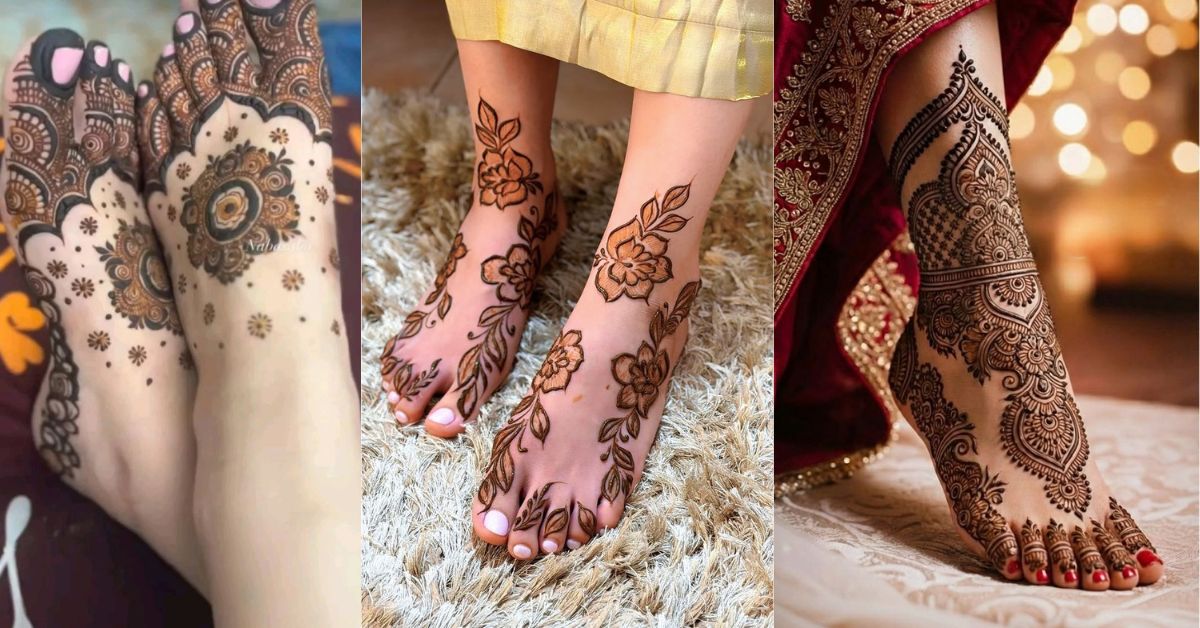
Arabic mehndi is loved for its flowing lines, graceful floral patterns, leafy trails, and open spaces. While Arabic designs are often associated with hands, they look equally beautiful when adapted to the feet. From delicate vines around the toes to bold floral trails across the ankle, Arabic Foot Mehndi Designs can create an elegant look without making the feet appear overly crowded.
For weddings, Eid, family celebrations, festive gatherings, or even a simple mehndi day at home, foot mehndi can add a beautiful finishing touch to your overall look. The best part is that Arabic-inspired patterns are flexible. You can choose a very simple design if you prefer minimal decoration or a more detailed pattern when you want something eye-catching.
At Mehndi Crafted, we love exploring mehndi ideas that combine traditional beauty with modern simplicity. In this guide, you will find ideas for different styles, occasions, and preferences so you can choose a foot design that suits you perfectly.
What Makes Arabic Foot Mehndi Designs So Beautiful?
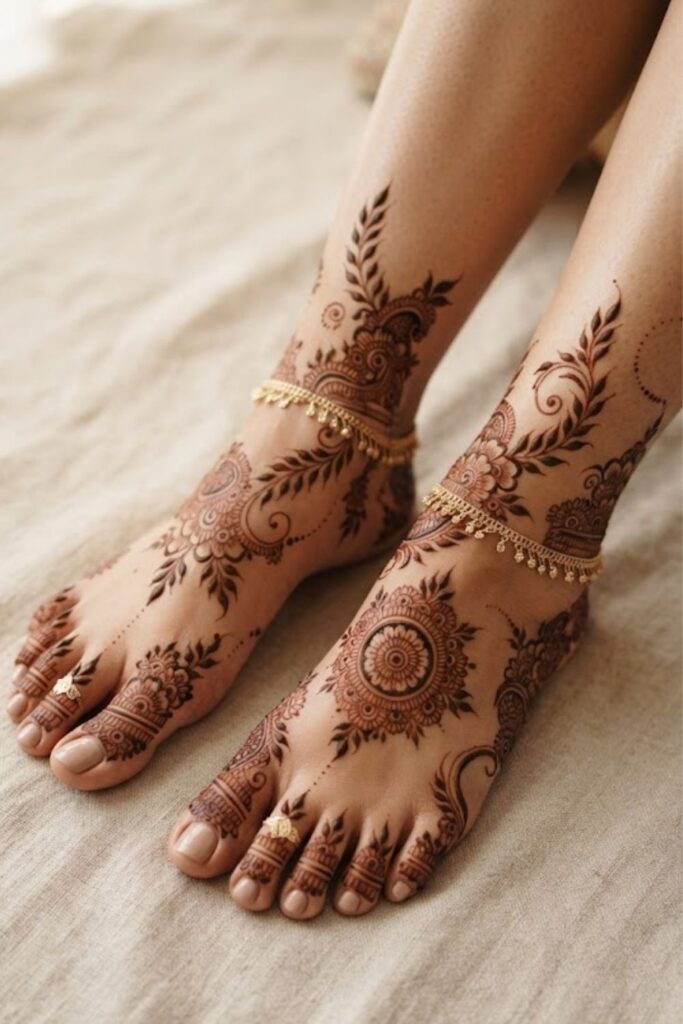
Arabic mehndi has a distinctive visual style. Instead of filling every area with dense patterns, it usually focuses on flowing compositions made from flowers, leaves, vines, curves, and decorative elements.
When these features are used on the feet, they can beautifully follow the natural shape of the feet.
Some of the most attractive characteristics include:
- Flowing floral vines
- Large statement flowers
- Curved leafy trails
- Open negative space
- Delicate toe patterns
- Ankle-inspired bracelet designs
- Paisley elements
- Fine curved lines
- Minimal dots and accents
- Asymmetrical compositions
This combination makes Arabic Foot Mehndi Designs especially suitable for women who want an elegant appearance without covering their entire feet with heavy mehndi.
1. Simple Floral Foot Mehndi
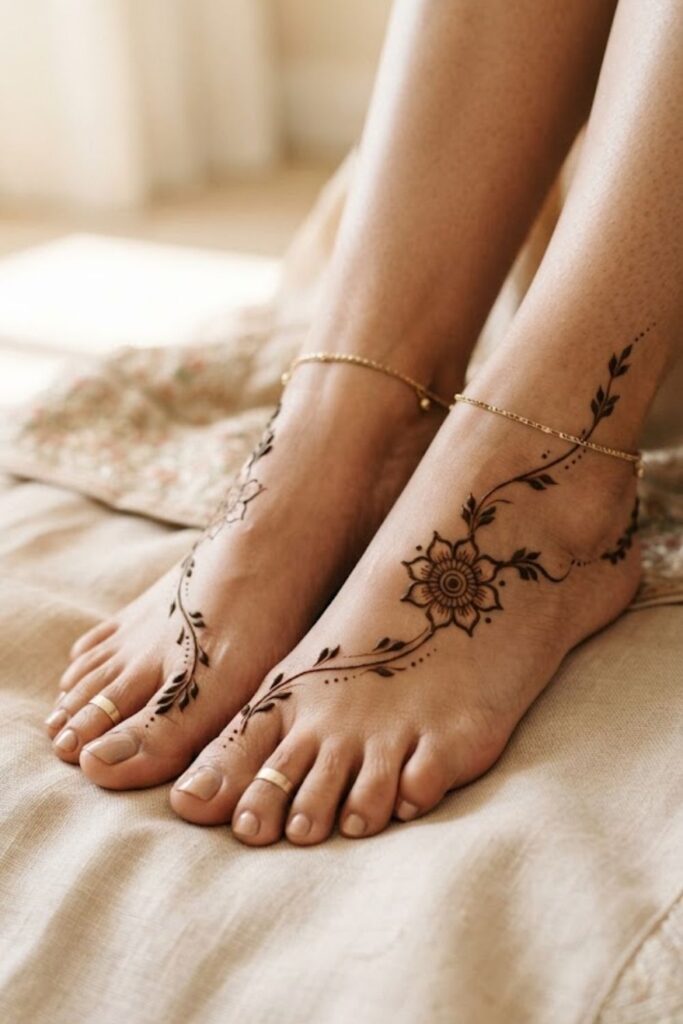
A simple floral design is an excellent starting point for anyone who prefers understated mehndi. Begin with a medium-sized flower near the center or side of the foot and extend a leafy vine toward the ankle.
Keep the leaves relatively small and leave enough space between the elements. This creates a clean and modern appearance.
This style works particularly well for casual events, Eid celebrations, or women who are trying foot mehndi for the first time.
2. Elegant Leafy Vine Design
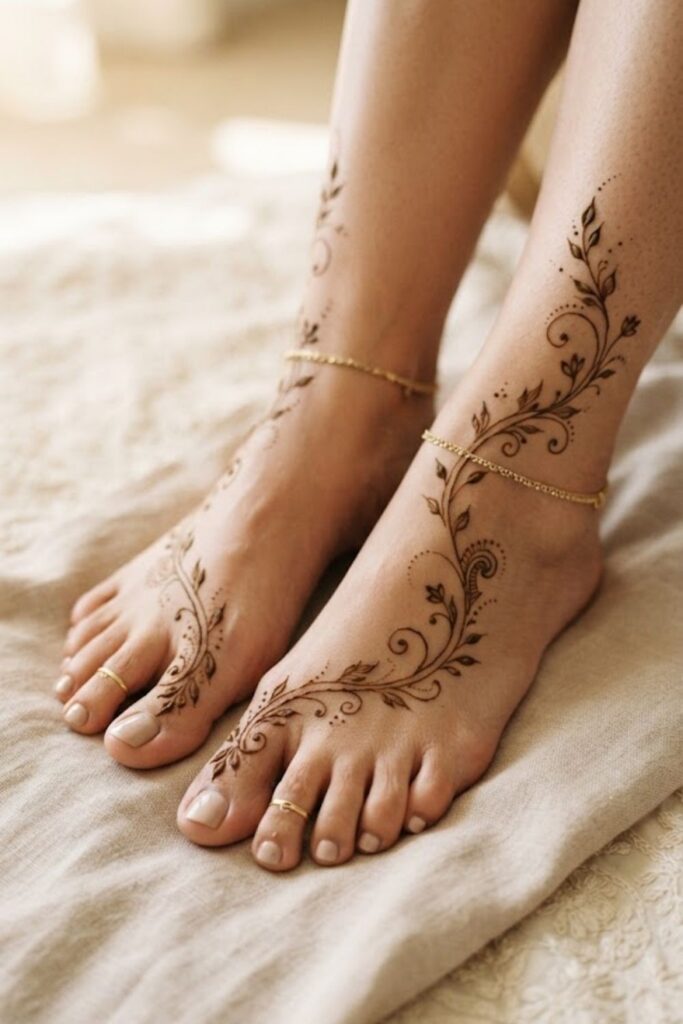
Leafy vines are one of the easiest ways to create an Arabic-inspired appearance. A thin curved line can travel from the side of the foot toward the ankle, with leaves placed along the vine.
For a delicate result, alternate the direction of the leaves instead of placing them in a straight row.
This is one of the most versatile Arabic Foot Mehndi Designs because you can make it extremely simple or gradually add flowers and dots for more detail.
3. Arabic Ankle Trail
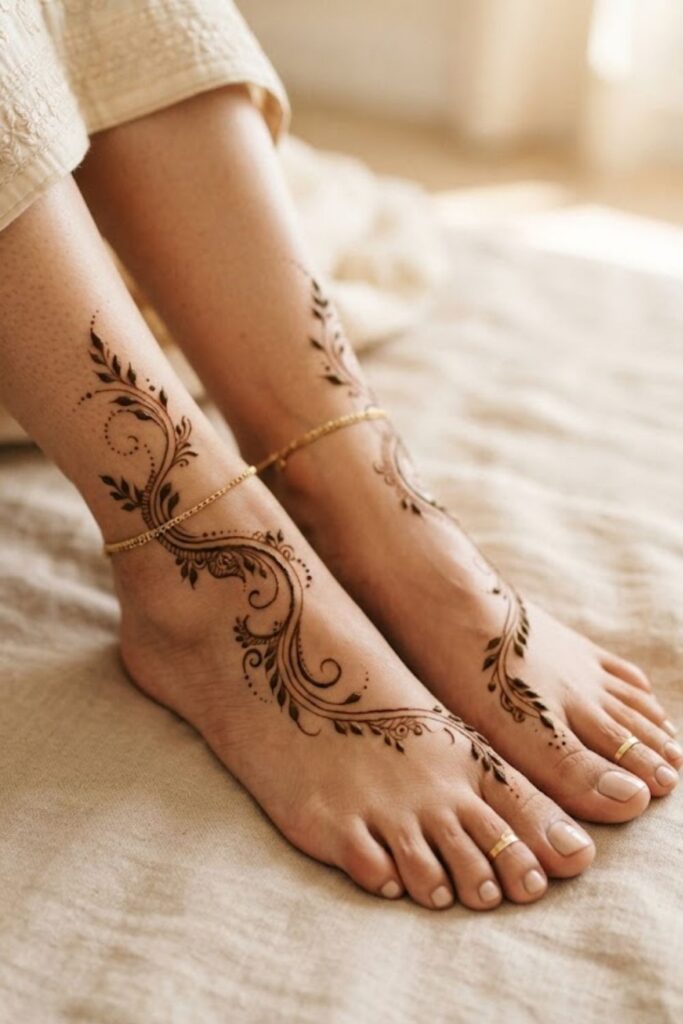
An ankle trail can make foot mehndi look more like a piece of delicate jewelry. The design begins near the foot and curves upward toward the ankle.
You can use:
- Leaves
- Small flowers
- Dots
- Curved lines
- Tiny paisleys
Avoid filling the entire ankle area. A partial trail often looks more graceful and allows the design to breathe.
4. Minimal Toe Mehndi Design
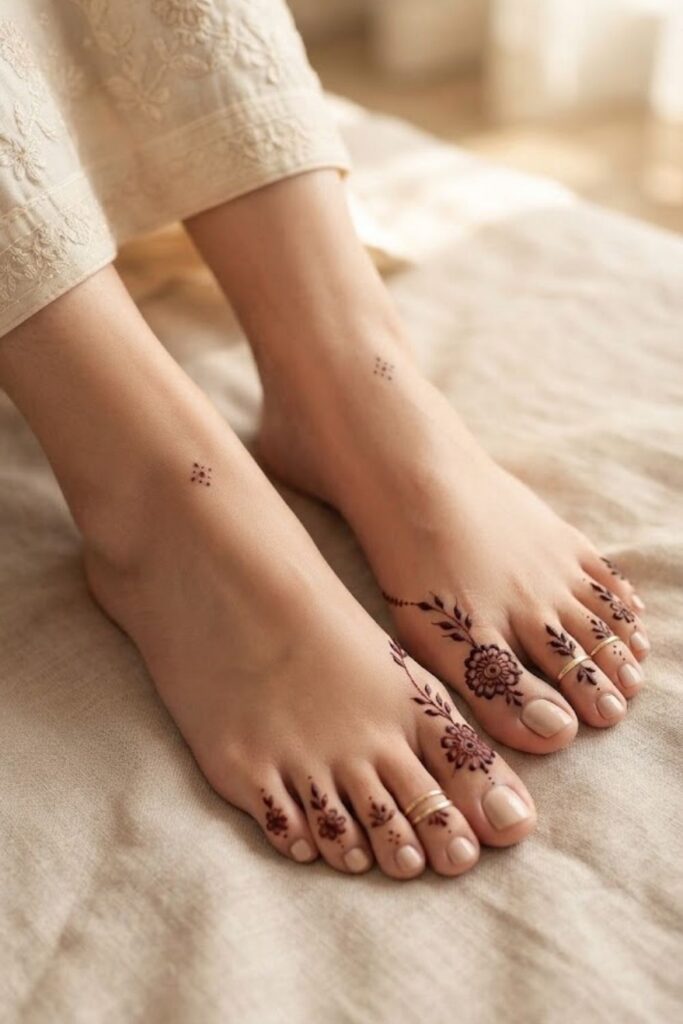
If you don’t want mehndi covering the entire foot, focus on the toes.
Small floral or leafy details can be applied to one or two toes while the remaining toes are left natural. A tiny central motif on the upper foot can connect the design visually.
Minimal toe patterns are perfect for people who want a fashionable mehndi look that doesn’t feel heavy.
5. Arabic Floral Foot Trail
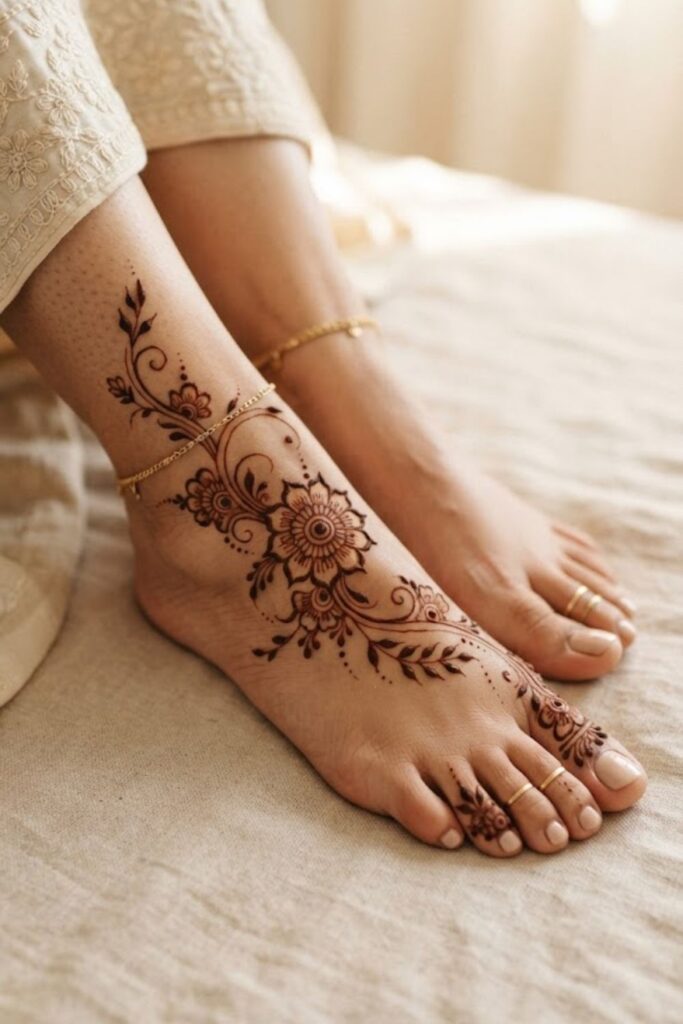
A floral trail combines flowers and leaves in a diagonal composition. Instead of placing the motifs directly in the center, start from one side of the foot and gradually move toward the opposite direction.
The diagonal placement creates movement and makes the foot appear longer.
For an elegant result, use one larger flower as the main focal point and surround it with smaller leaves and buds.
6. Simple Arabic Foot Mehndi Designs for Beginners
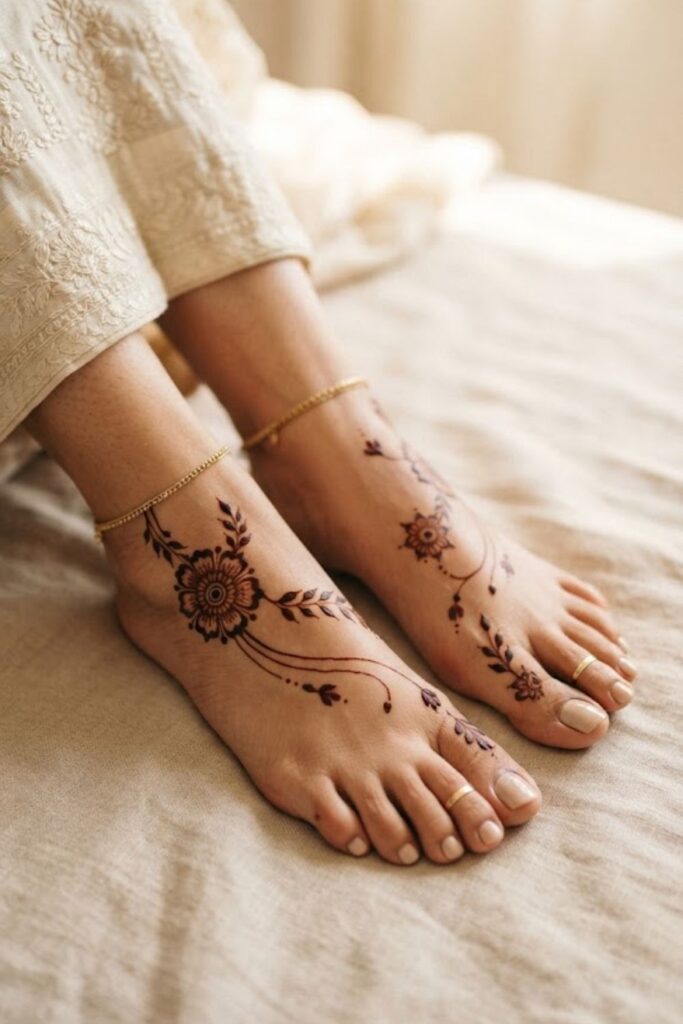
Beginners often feel nervous about creating complicated patterns on the feet. Fortunately, you don’t need advanced skills to achieve a beautiful Arabic style.
Start with three basic components:
- A curved vine
- Simple leaves
- One or two flowers
Draw the main vine first. Add leaves along the curve, then place a flower near the strongest focal point.
Once the basic structure is complete, add a few dots to fill awkward gaps.
This approach is much easier than attempting an extremely detailed design from the beginning.
7. Arabic Paisley Foot Design
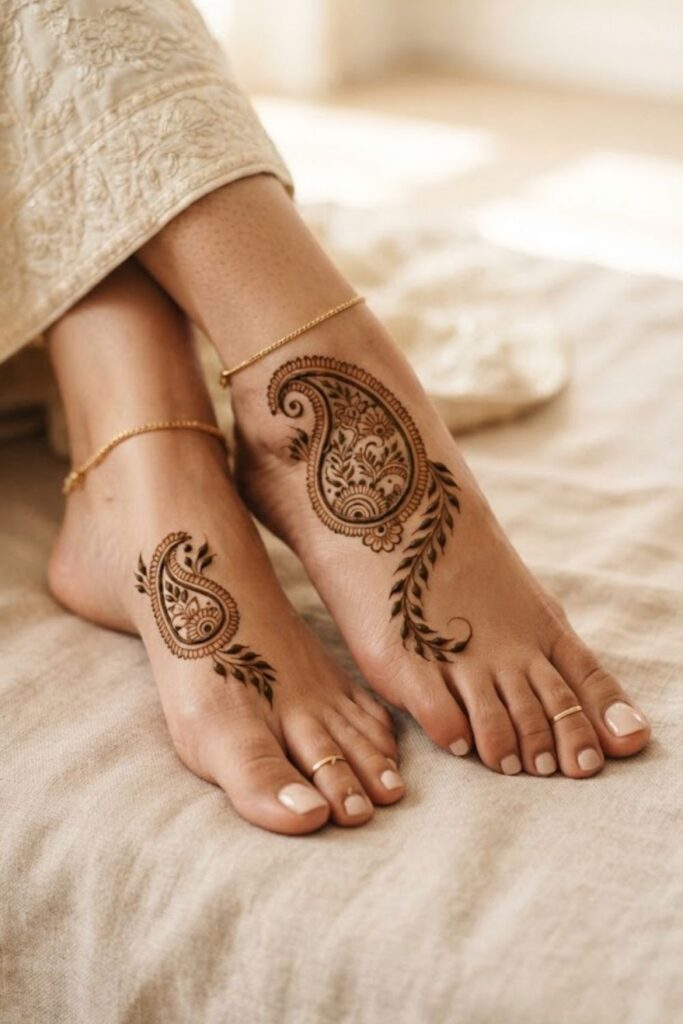
Paisley motifs are another beautiful addition to Arabic-inspired mehndi. A single paisley can be placed on the upper foot and surrounded by small leaves.
For a modern look, avoid filling the paisley. Instead, decorate its interior with:
- Small leaves
- Curved strokes
- Dots
- Tiny flowers
- Fine parallel lines
The surrounding negative space will make the paisley stand out.
8. Floral Bracelet Around the Ankle
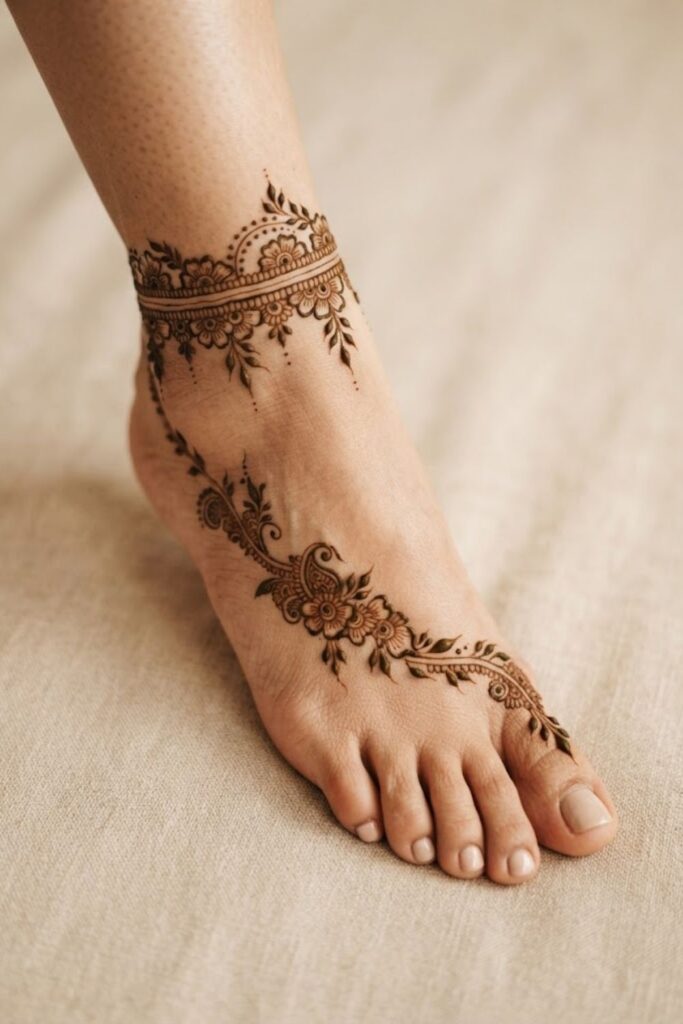
If you love jewelry-inspired mehndi, consider creating a floral bracelet around the ankle.
Use a thin curved line as the base and decorate it with small flowers and leaves. You can leave a small opening at one side to make the design look more natural.
This style works beautifully with traditional outfits because it resembles a delicate anklet.
9. Arabic Rose Foot Mehndi
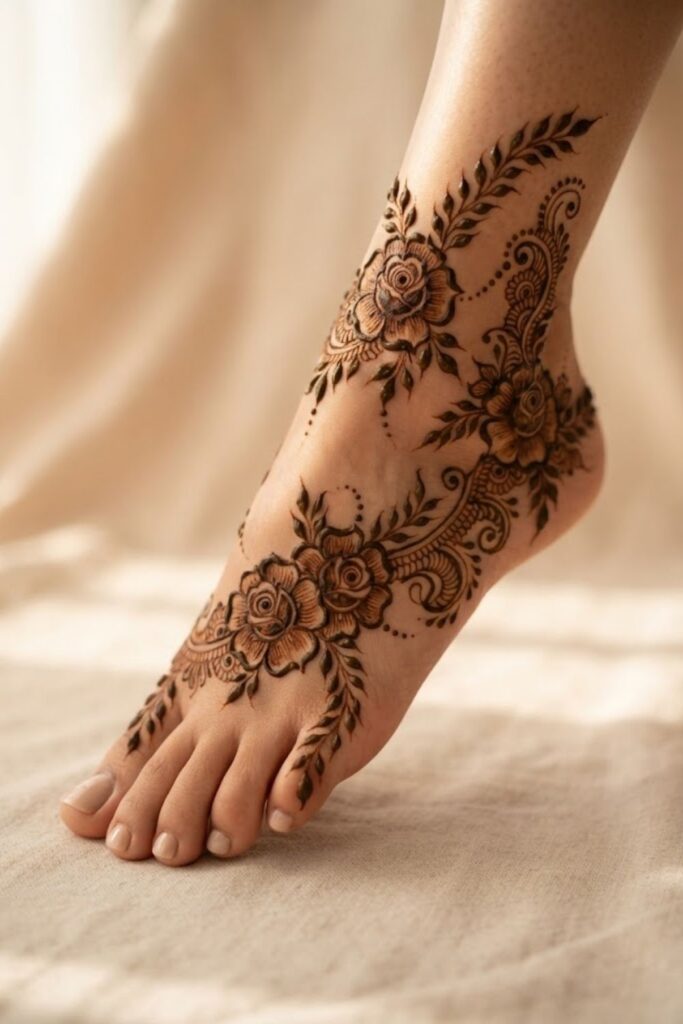
Roses can become the main attraction of your foot design. A medium-sized rose placed near the upper foot can be connected to a flowing leafy branch.
Keep the rose slightly larger than the surrounding elements so it becomes the focal point.
For a balanced composition, use smaller leaves rather than adding several large flowers.
10. Half-Foot Arabic Mehndi
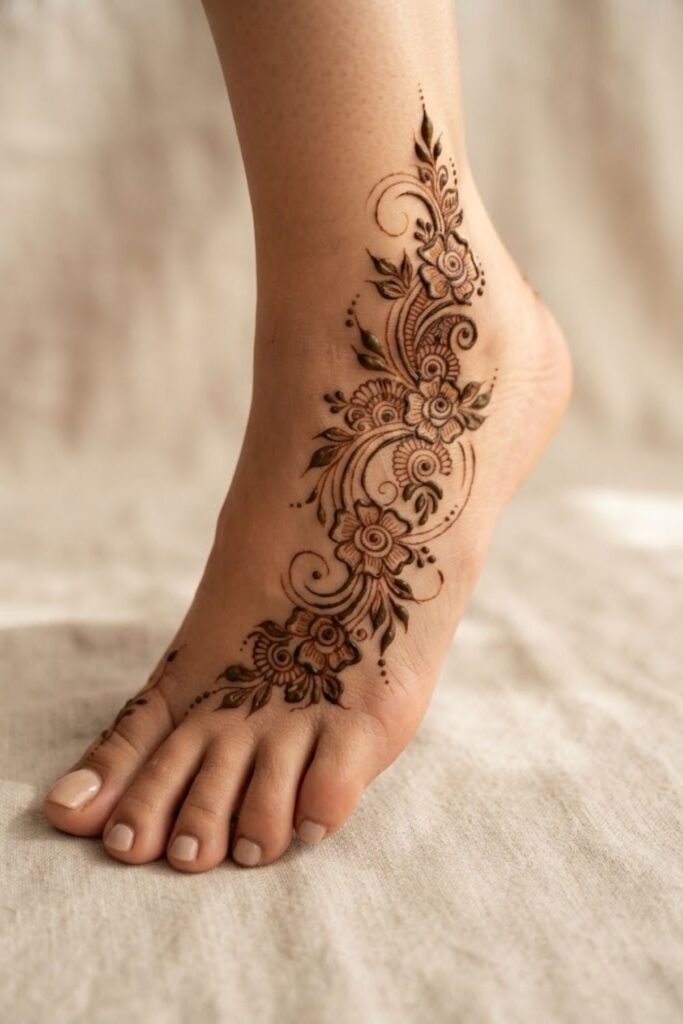
You don’t always need to cover the entire foot. A half-foot design can decorate one side while leaving the rest completely open.
For example, you can create a floral trail starting near the toes and extending diagonally toward the ankle.
This style is particularly attractive for modern bridesmaids, Eid outfits, and festive looks where you want the mehndi to complement rather than dominate your appearance.
11. Arabic Foot Mehndi With Dots
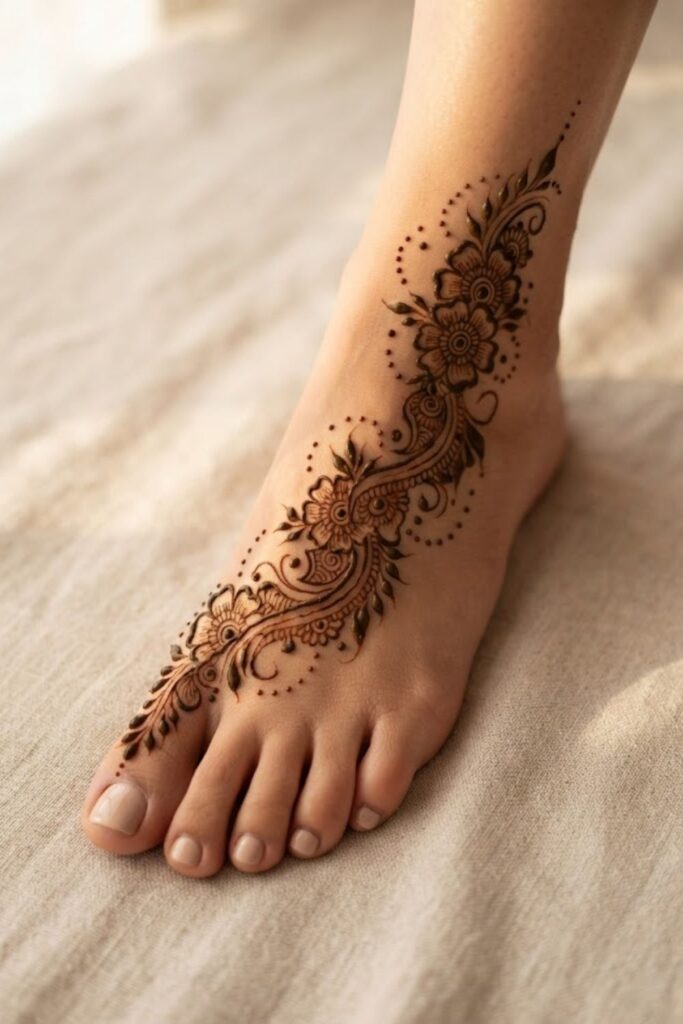
Dots may seem like a small detail, but they can make a simple design look polished.
After completing the main floral and leafy elements, place tiny dots around selected areas. Avoid adding dots everywhere.
A few carefully positioned dots can:
- Connect separate motifs
- Fill small empty spaces
- Highlight curves
- Add delicacy
- Improve visual balance
The key is moderation.
12. Simple Floral and Leaf Combination
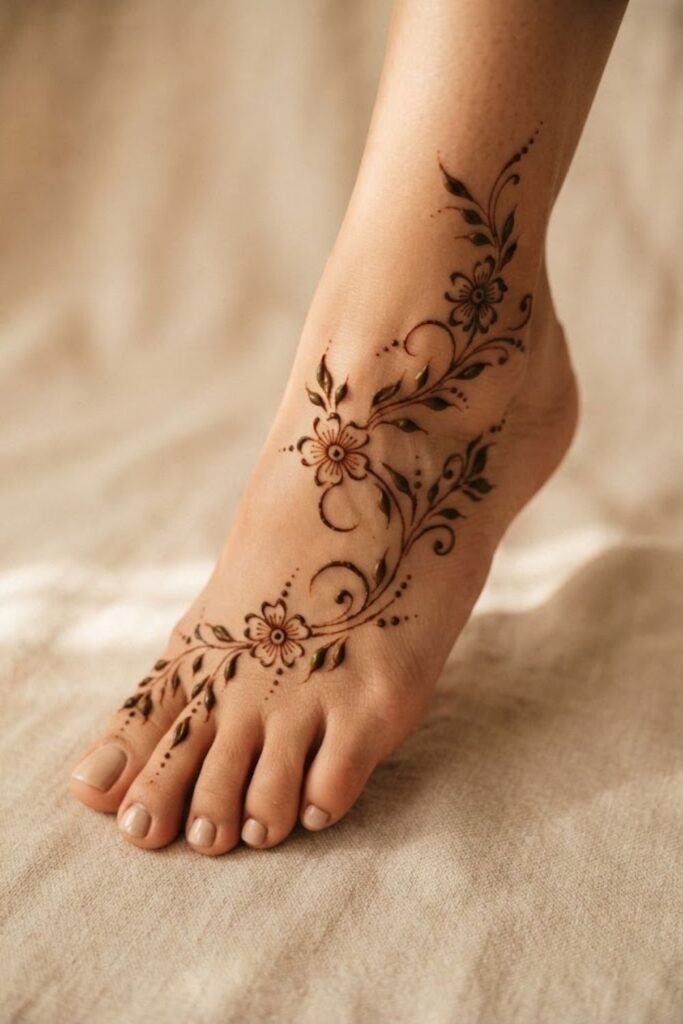
For a very easy design, combine one flower with a short leafy branch.
Place the flower near the center of the foot and allow the branch to curve naturally toward the ankle or toes.
This is a great option when you need something quick but still want your mehndi to look intentional and elegant.
13. Elegant Foot Mehndi With Open Spaces
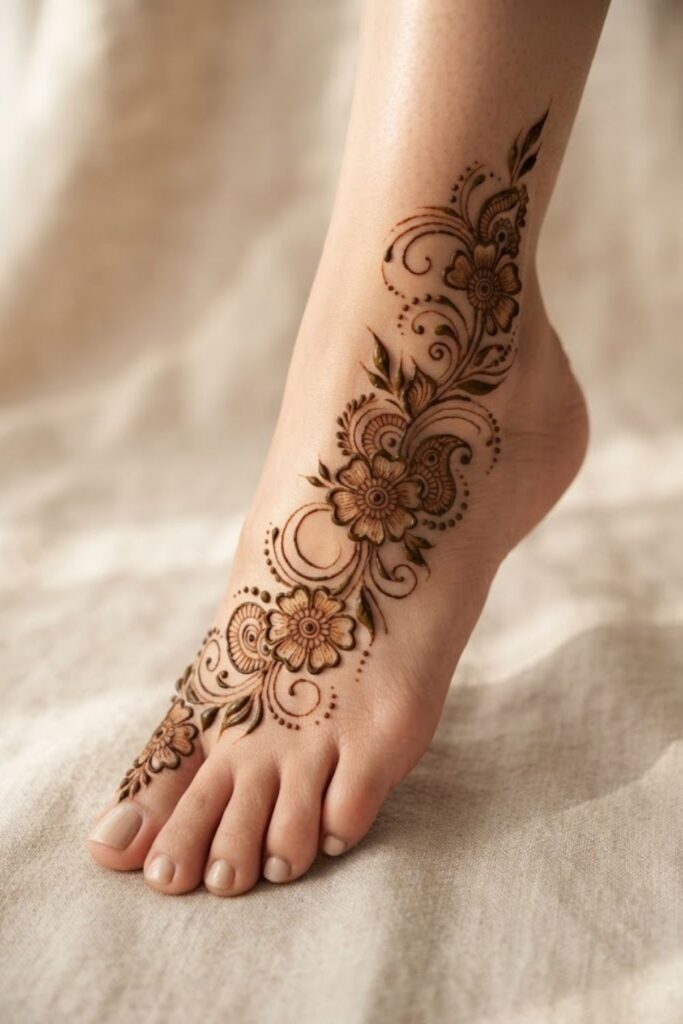
Negative space is an important part of modern Arabic mehndi. Rather than filling every section, leave areas of bare skin visible.
The contrast between decorated and undecorated areas makes the pattern easier to appreciate.
A good rule is to think of the space as part of the design rather than as an unfinished area.
14. Arabic Foot Mehndi With Bold Flowers
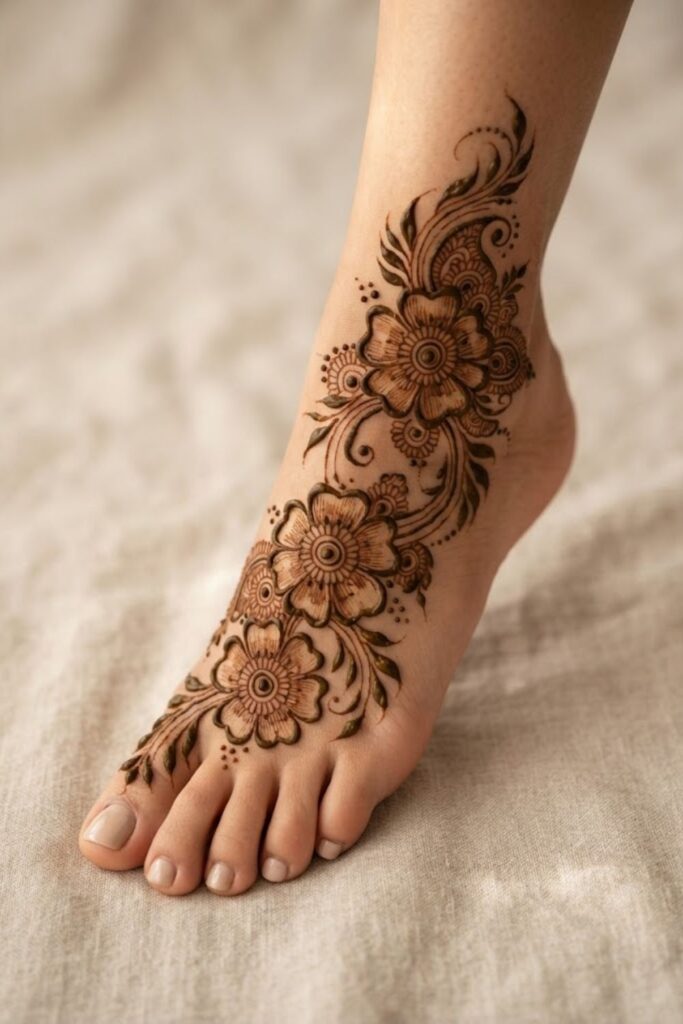
If you prefer a stronger appearance, choose one or two bold flowers and surround them with medium-sized leaves.
Bold flowers can work especially well for weddings because they remain visually noticeable even when paired with traditional clothing.
Keep the surrounding details lighter so the flowers remain the main attraction.
15. Delicate Arabic Foot Vine
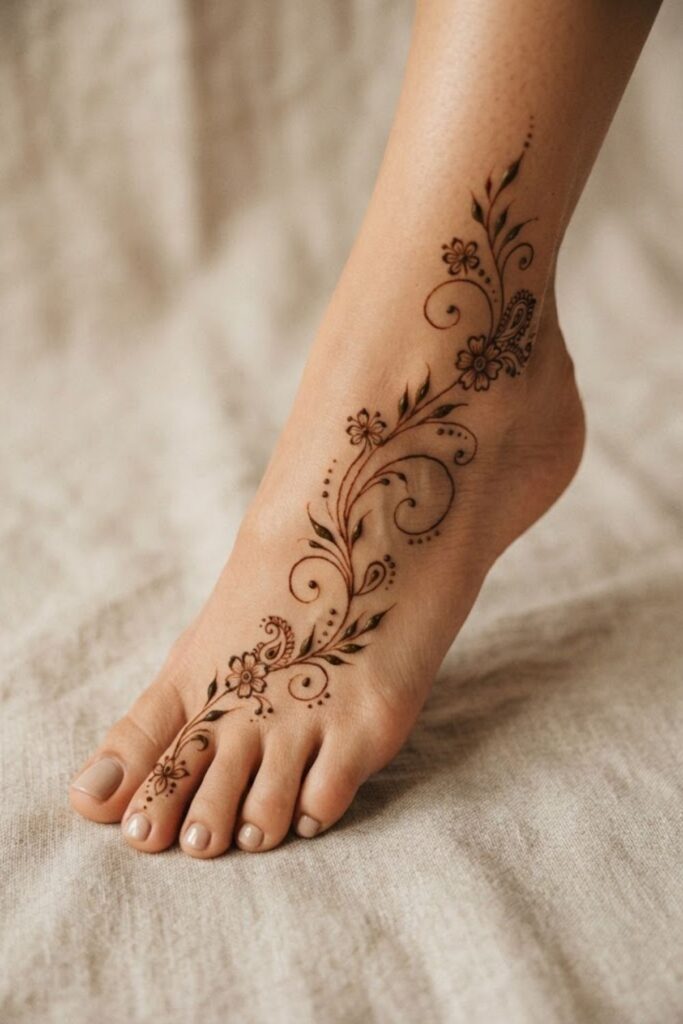
A thin vine can create a sophisticated appearance with very little effort.
Start near the toes and gradually curve the vine toward the side of the foot. Add small leaves at irregular intervals rather than placing them perfectly symmetrically.
This gives the design a more natural, hand-drawn appearance.
How to Choose the Right Arabic Foot Mehndi Design
Choosing a design is easier when you consider the occasion, outfit, and amount of time available.
For Eid
Choose a light floral or leafy design. Eid mehndi doesn’t necessarily need to be heavy. A simple vine with flowers can look beautiful with traditional clothing.
For Weddings
Wedding celebrations allow more detailed patterns. Consider floral trails, paisleys, roses, and ankle bracelet elements.
For Bridesmaids
A medium-detail design is usually ideal. You can coordinate the colors and style of your outfit with a graceful foot pattern.
For Beginners
Start with a simple vine, leaves, and a small flower. Avoid very dense patterns until you become comfortable working on the curved surface of the foot.
For Minimalist Looks
Choose toe mehndi, a single floral motif, or a thin ankle trail.
Why Simple Designs Are Becoming More Popular
Many people now prefer mehndi that looks elegant without requiring hours of application. This is one reason simple Arabic patterns continue to be popular.
A simple composition has several advantages:
- It takes less time to apply.
- It is easier for beginners.
- It photographs beautifully.
- It works with modern outfits.
- It doesn’t hide the natural shape of the foot.
- It can be customized easily.
The beauty of Arabic Foot Mehndi Designs is that simplicity doesn’t mean boring. A carefully placed flower, curved vine, and a few leaves can create a sophisticated result.
Tips for Getting a Beautiful Mehndi Result
Before applying mehndi to your feet, clean the skin and make sure it is free from oils and heavy creams. Oily skin can make it harder for the paste to adhere properly.
Plan the design before starting. If you are using a reference image, understand where the major flower or focal motif will go.
Keep your cone tip clean and use steady pressure. Don’t worry if every line isn’t perfectly identical. Hand-applied mehndi naturally has small variations, and those imperfections can make the design look authentic.
Allow the paste to dry properly and avoid rubbing it off immediately. The final stain develops gradually after the dried paste is removed.
How to Make Foot Mehndi Look More Elegant
A beautiful design is not only about the individual motifs. Placement is equally important.
Follow the Natural Shape of the Foot
The foot has curves and different sections. Your design should work with those curves.
A straight horizontal pattern may look less natural, while a curved vine can follow the foot beautifully.
Keep One Main Focal Point
Avoid making every flower the same size.
Choose one main motif and allow smaller elements to support it. This creates visual hierarchy.
Use Negative Space
Don’t be afraid to leave areas empty.
Negative space helps the viewer recognize the individual elements and prevents the design from looking messy.
Balance Both Feet
If you are applying mehndi to both feet, the designs don’t necessarily have to be identical.
You can create complementary patterns.
For example, one foot may feature a rose while the other has a large flower with a similar leafy trail.
This creates an artistic but coordinated appearance.
Arabic Foot Mehndi for Different Occasions
Eid Celebrations
Eid is a perfect occasion for light and elegant mehndi. Choose flowers, leaves, crescents, or small festive motifs.
Simple patterns can be completed quickly before Eid prayers, family gatherings, or celebrations.
Wedding Functions
For weddings, more elaborate patterns are appropriate.
You can include larger flowers, paisleys, peacock motifs, ankle bracelets, and detailed borders.
Engagement Events
An engagement design can be elegant without being extremely heavy. A rose-and-vine composition or floral ankle design can complement formal clothing beautifully.
Festivals
For cultural festivals, bold floral trails and traditional motifs can create a festive appearance.
Casual Mehndi Days
If you simply enjoy mehndi, choose a small design that can be completed in a short time.
A simple vine across the upper foot is enough to create a stylish look.
How to Make Simple Arabic Foot Mehndi Designs at Home
You don’t need professional equipment to practice.
Start by gathering:
- A good-quality mehndi cone
- Tissue or cotton for cleaning mistakes
- A reference design
- A comfortable place to sit
- Clean skin
First, sketch the basic direction of your design mentally. Decide where your largest flower will be placed.
Then draw the main vine.
After that, add leaves and secondary flowers.
Finally, use dots and tiny decorative strokes to complete the composition.
If you make a mistake, don’t panic. Small corrections are normal when applying mehndi by hand.
Common Mistakes to Avoid
Making the Design Too Dense
One of the biggest mistakes is trying to fill every space.
Arabic designs look beautiful partly because of their open areas.
Using Too Many Large Motifs
Multiple large flowers can compete for attention.
Use one dominant motif and smaller supporting details.
Ignoring Foot Shape
A design that looks beautiful on paper may not look the same when applied to a curved foot.
Adapt the pattern to the shape of your skin.
Applying Uneven Pressure
If you squeeze the cone too hard, the lines may become unnecessarily thick.
Practice maintaining consistent pressure.
Choosing a Design Beyond Your Skill Level
If you are a beginner, start simple. You can gradually move toward more detailed designs as your control improves.
Styling Your Foot Mehndi With Your Outfit
Your outfit can influence the type of mehndi you choose.
With heavily embroidered clothing, a simple design may create better balance.
With a plain or minimally decorated outfit, you can choose a more detailed floral composition.
Open footwear can also highlight ankle-focused patterns, while traditional shoes may cover some of the design.
Jewelry is another consideration. If you are wearing a detailed anklet, avoid creating an extremely busy ankle mehndi pattern.
Choosing Between Simple and Detailed Arabic Foot Mehndi
Both styles have their advantages.
Simple Designs
Best for:
- Beginners
- Short events
- Eid
- Casual wear
- Minimalist fashion
- Quick application
Detailed Designs
Best for:
- Brides
- Weddings
- Engagements
- Formal celebrations
- Traditional events
There is no universally perfect style. The best design is the one that matches your occasion and personal taste.
Quick Guide: Which Arabic Foot Design Should You Choose?
| Your Preference | Recommended Style |
| Beginner | Simple leafy vine |
| Minimal look | Toe or half-foot design |
| Eid | Floral or crescent motif |
| Wedding | Floral and paisley composition |
| Bridal | Detailed floral trail |
| Modern style | Thin-line minimalist design |
| Jewelry-inspired | Floral ankle bracelet |
| Bold look | Large rose or flower |
| Natural style | Leafy vine |
| Quick application | One-flower design |
How to Prepare Your Feet Before Applying Mehndi
Clean skin provides a better surface for mehndi.
Wash your feet gently and remove any lotion, oil, or heavy moisturizer before application. Let the skin dry completely.
If you have recently applied a thick cream, wait until the skin is clean and dry before beginning.
You can also keep your design reference ready so you don’t have to repeatedly touch your phone while working.
How to Apply Arabic Foot Mehndi Step by Step
Step 1: Decide the Main Placement
Before touching the cone to your skin, decide whether the design will be centered, diagonal, side-focused, or ankle-focused.
Step 2: Create the Main Motif
Start with the largest flower, paisley, or central element.
This gives you a visual anchor for the rest of the design.
Step 3: Add the Vine
Draw a curved line extending from the main motif.
Don’t worry about making it perfectly straight. Arabic-inspired designs often look better with natural curves.
Step 4: Add Leaves
Place leaves along the vine. Vary their size slightly to create a more natural appearance.
Step 5: Add Small Flowers
Use smaller flowers to connect the main elements.
Avoid placing them too close together.
Step 6: Add Decorative Details
Finally, add dots, short lines, tiny buds, or other details where necessary.
Step back and look at the whole design before adding more.
How to Make Your Mehndi Stain Look Better
The final stain depends on several factors, including the quality of the henna paste, skin chemistry, application technique, and aftercare.
Allow the paste to dry naturally.
Once the paste has dried, avoid immediately washing the area with water. Gently remove the dried paste according to the instructions you are following.
The stain may initially appear orange or light brown. It generally becomes darker over time as it oxidizes.
Avoid expecting the darkest color immediately after removing the paste.
Safety Tips for Foot Mehndi
Natural henna is generally preferred for traditional mehndi application, but it’s important to know what is in the product you are using.
Avoid unknown products that promise an extremely dark stain very quickly.
Be especially careful with products marketed as “black henna,” as some may contain chemicals that can cause serious skin reactions.
If you are unsure about a product, check its ingredients and use a reputable source.
How Long Does Foot Mehndi Usually Last?
Mehndi gradually fades as the outer layers of the skin naturally shed.
How long the design remains visible depends on:
- Skin type
- Location of application
- Washing frequency
- Product quality
- Aftercare
- Everyday activity
Because feet experience friction from footwear and walking, foot mehndi may fade differently from designs on less-used areas.
How to Keep Foot Mehndi Looking Attractive
You cannot prevent natural fading completely, but gentle care can help preserve the appearance.
Try to avoid unnecessary scrubbing and harsh exfoliation immediately after application.
Moisturizing after the initial stain has developed can help keep the skin comfortable, although the effect on stain longevity varies.
Frequently Asked Questions
What are Arabic Foot Mehndi Designs?
Arabic Foot Mehndi Designs are henna patterns inspired by the flowing floral, leafy, paisley, and vine-based style commonly associated with Arabic mehndi. They often use open spaces and curved compositions instead of covering the entire foot with dense patterns.
Are Simple Arabic Foot Mehndi Designs Good for Beginners?
Yes. Simple Arabic Foot Mehndi Designs are often easier for beginners because they usually rely on basic flowers, leaves, vines, and dots rather than highly intricate filling.
Which foot mehndi design is best for Eid?
A floral vine, leafy trail, crescent motif, or simple ankle design can work beautifully for Eid. Choose a pattern that complements your outfit and doesn’t require more application time than you have available.
Can Arabic foot mehndi be used for weddings?
Absolutely. Bridal and wedding designs can include larger flowers, paisleys, peacocks, detailed vines, ankle bracelets, and decorative borders.
How can I make foot mehndi look elegant?
Focus on clean lines, balanced placement, one main focal motif, and sufficient negative space. Adding too many details does not necessarily make a design more beautiful.
Should both feet have the same design?
Not necessarily. Matching designs create a traditional appearance, while complementary designs can give a more modern artistic effect.
What is the easiest Arabic foot mehndi design?
A curved leafy vine with one or two flowers is among the easiest options. You can gradually add dots and small decorative details as your confidence improves.
How do I choose between a simple and detailed foot design?
Consider your occasion, available time, experience, outfit, and personal preference. Simple designs are practical for casual events, while detailed patterns are better suited to weddings and formal celebrations.
Can I combine Arabic and Indian mehndi styles?
Yes. Mehndi styles can be creatively combined. For example, you can use an Arabic floral trail with Indian-style fine details inside selected motifs.
How can I practice foot mehndi?
Practice individual flowers, leaves, curves, paisleys, and vines on paper first. Once your cone control improves, practice on a surface that allows you to understand how the lines behave.
Conclusion
Beautiful foot mehndi doesn’t have to be complicated. The most attractive patterns often come from thoughtful placement, graceful curves, floral motifs, leafy vines, and well-balanced negative space.
Whether you are searching for Arabic Foot Mehndi Designs for Eid, a wedding, an engagement, or a simple mehndi session at home, there are plenty of options to explore. Beginners can start with a single flower and leafy vine, while experienced mehndi lovers can experiment with paisleys, roses, peacocks, ankle bracelets, and detailed floral trails.
Simple Arabic Foot Mehndi Designs are particularly useful when you want a stylish result without spending hours on application. Meanwhile, more elaborate patterns can provide the richness needed for bridal and formal occasions.
At Mehndi Crafted, our goal is to make mehndi inspiration easy to explore and enjoyable to recreate. Choose a design that fits your personality, adapt it to the natural shape of your feet, and don’t be afraid to leave some areas beautifully bare.
The perfect mehndi design is not necessarily the most complicated one. It is the one that makes you feel confident, elegant, and happy when you look at it.