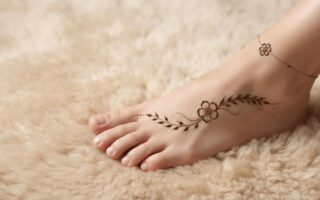
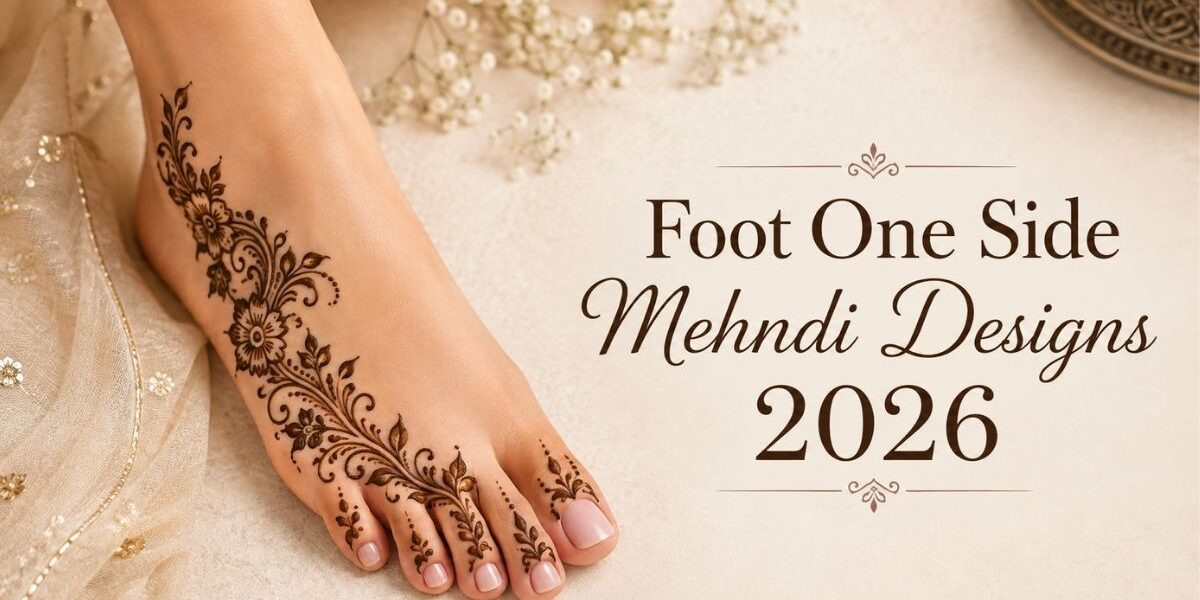
Foot mehndi has always been a beautiful way to decorate the feet for weddings, Eid, festivals, and special celebrations. In 2026, however, many women are moving toward designs that look elegant without covering the entire foot. This is where Foot One Side Mehndi Designs 2026 are becoming a popular choice.
Instead of filling the complete foot with heavy patterns, a one-side design usually follows one edge of the foot, creating a graceful trail from the toes toward the ankle. This style gives you the beauty of traditional henna while keeping part of the skin open and clean.
At Mehndi Crafted, we love designs that combine traditional beauty with modern simplicity. One-side foot mehndi is especially suitable for women who want an attractive design that is easy to apply, comfortable to wear, and visually balanced.
Whether you prefer floral patterns, leafy vines, Arabic details, delicate dots, or a more festive design, there are plenty of options to explore.
What Are One-Side Foot Mehndi Designs?
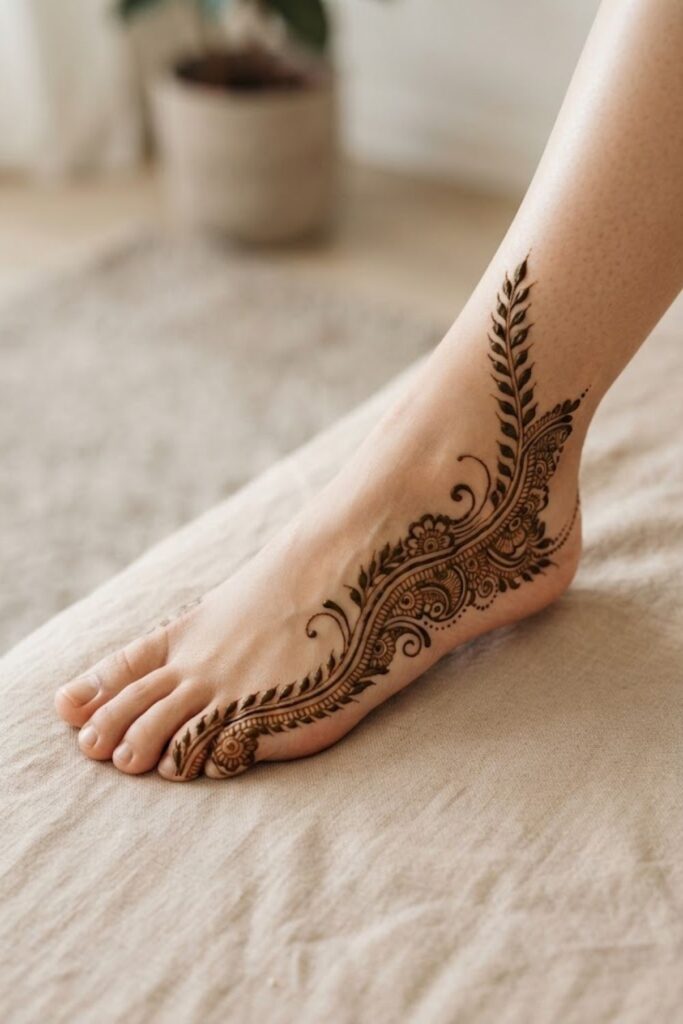
One-side foot mehndi designs are henna patterns created mainly along one side or edge of the foot rather than covering the entire surface.
The design may begin around the toes and continue diagonally toward the ankle. Another popular approach is to start from the side of the ankle and create a flowing trail toward the middle or front of the foot.
The main idea is to maintain open spaces while allowing the mehndi pattern to create a beautiful visual flow.
This makes Foot One Side Mehndi Designs 2026 particularly appealing to people who prefer modern and minimal henna.
Some common elements include:
- Flowers
- Leaves
- Vines
- Small paisleys
- Dots
- Curved lines
- Fine petals
- Arabic motifs
- Mandala-inspired details
- Small geometric elements
Because the design does not require complete foot coverage, it can also be quicker to apply than a heavy traditional foot mehndi pattern.
Beautiful Foot One Side Mehndi Designs 2026
After understanding the basics of one-side foot mehndi, it is time to explore different design ideas. The best thing about this style is that you do not have to follow one fixed pattern. You can mix flowers, leaves, vines, dots, paisleys, and Arabic elements according to your personal style.
Whether you want something very simple for Eid or a more detailed pattern for a wedding, Foot One Side Mehndi Designs 2026 offer plenty of creative possibilities.
1. Simple Floral One Side Foot Mehndi
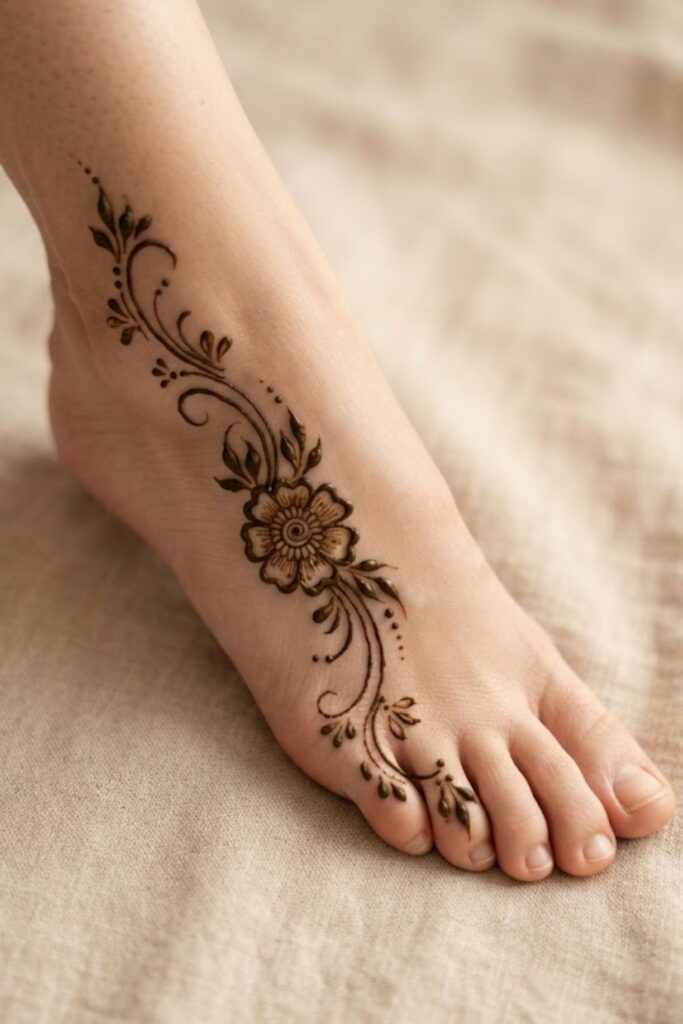
A simple floral design is one of the easiest choices for beginners.
Start with a medium-sized flower near the outer side of the foot. Add a few curved leaves around it and extend a thin vine toward the ankle.
Keep the center of the flower detailed while leaving the surrounding skin open.
This creates an elegant contrast between the henna and natural skin.
For an even simpler look, use only one main flower with three or four leaves. Small dots can be added around the design as delicate fillers.
This is a perfect simple one-side foot mehndi idea for women who prefer minimal decoration.
2. Arabic Floral Foot Trail
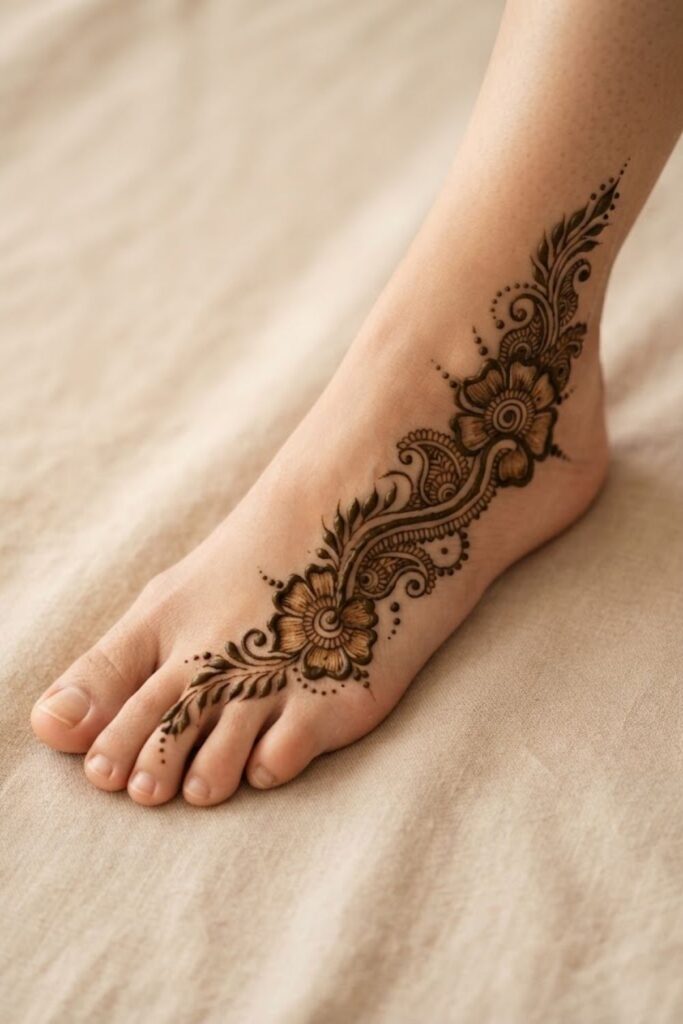
Arabic mehndi is famous for its flowing floral trails, making it naturally suitable for one-side foot designs.
Create a large flower close to the toes and continue the design diagonally toward the ankle with leaves and curved vines.
Do not connect every element tightly.
Instead, leave small gaps between the motifs.
The result is an elegant Arabic one-side foot mehndi pattern that feels modern while retaining traditional character.
For 2026, you can make the design more contemporary by using bold flowers with thinner surrounding vines.
3. One-Side Foot Mehndi With Large Flower
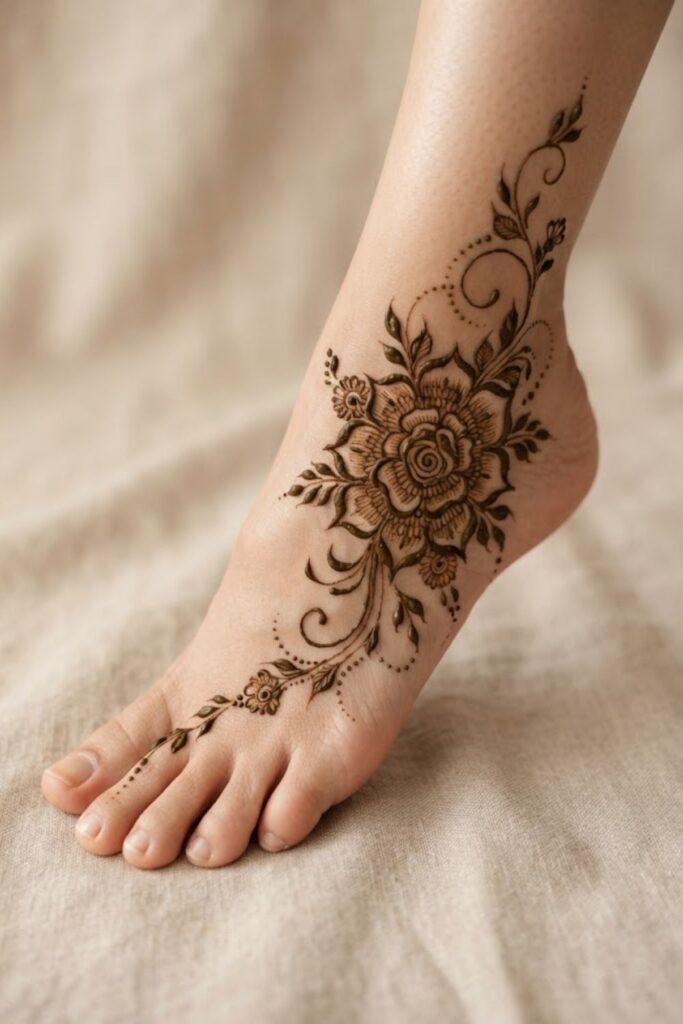
If you want your design to have one obvious focal point, choose a large flower.
The flower can be positioned near the center-side of the foot, while a delicate vine extends toward the toes and ankle.
Large flowers work particularly well when the rest of the foot is kept mostly empty.
This style is suitable for:
- Engagements
- Eid
- Family celebrations
- Bridal showers
- Wedding functions
A large floral motif can also look beautiful in photographs because its shape remains visible from a distance.
4. Leafy Vine From Toe to Ankle
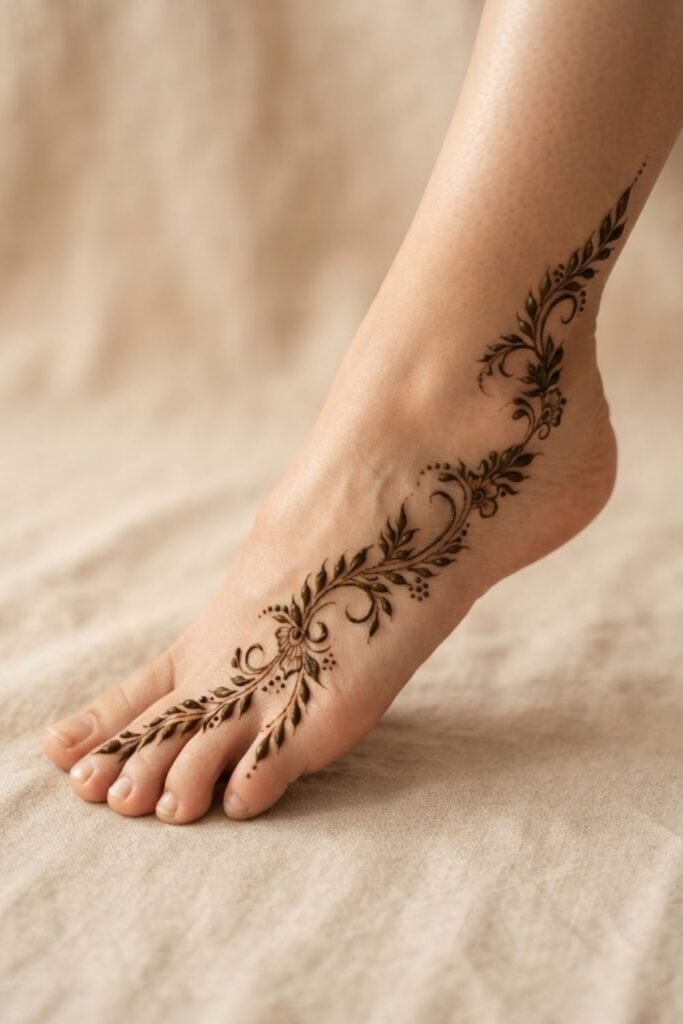
A leafy vine is another beautiful option for Foot One Side Mehndi Designs 2026.
Begin with a small pattern around one toe and gradually extend a curved vine toward the ankle.
Use leaves of different sizes to create a natural flow.
You can make the upper part slightly more detailed and gradually reduce the size of the motifs as the vine approaches the ankle.
This gives the design a graceful tapered effect.
5. Minimal Side Foot Mehndi With Dots
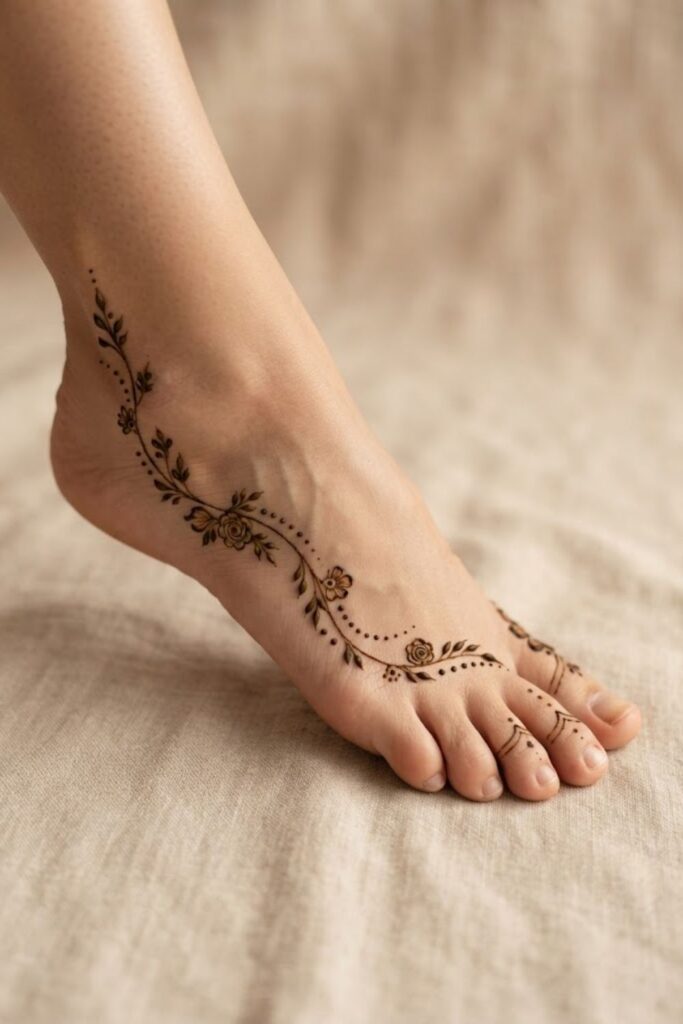
Dots are simple but powerful fillers.
For a minimalist design, draw a thin curved line along one side of the foot and add small leaves at intervals.
Finish the pattern with tiny dots around selected areas.
The dots should not be placed everywhere.
A few carefully positioned dots are enough to give the design a finished appearance.
This is one of the best choices if you are looking for a quick and easy design.
6. Arabic One Side Foot Mehndi With Bold Flowers
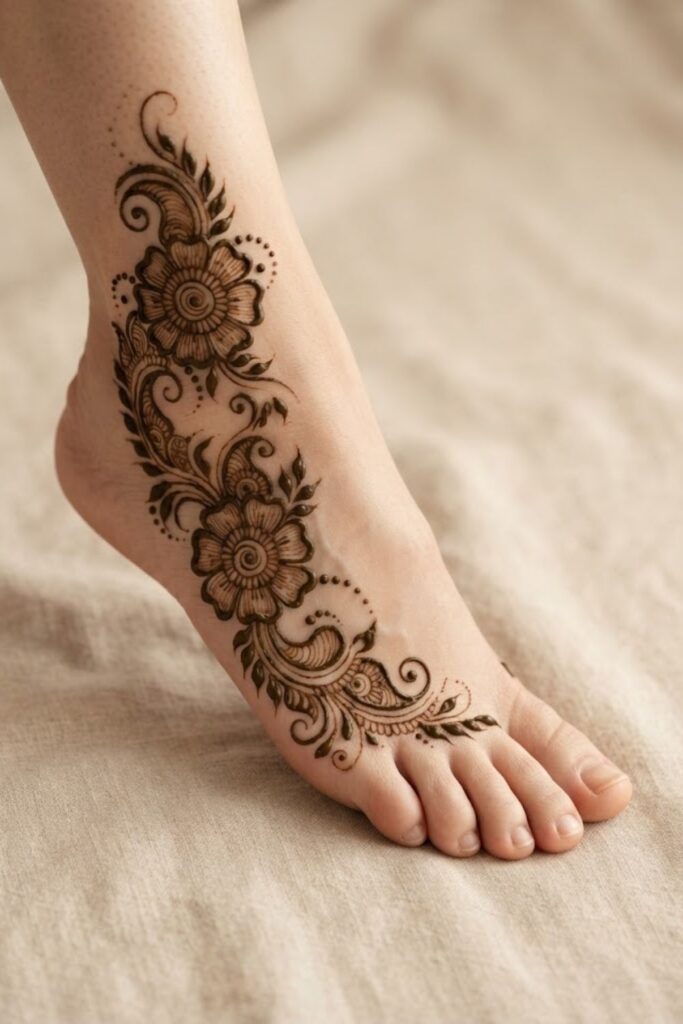
Women who love slightly heavier designs can choose bold Arabic flowers.
Create two or three large flowers along one side of the foot. Connect them with thick leafy vines and add small filler details around the edges.
The key is to keep the opposite side of the foot open.
That open area prevents the design from becoming too dense.
This combination of bold motifs and negative space is one of the defining characteristics of modern Foot One Side Mehndi Designs 2026.
7. One-Side Paisley Foot Design
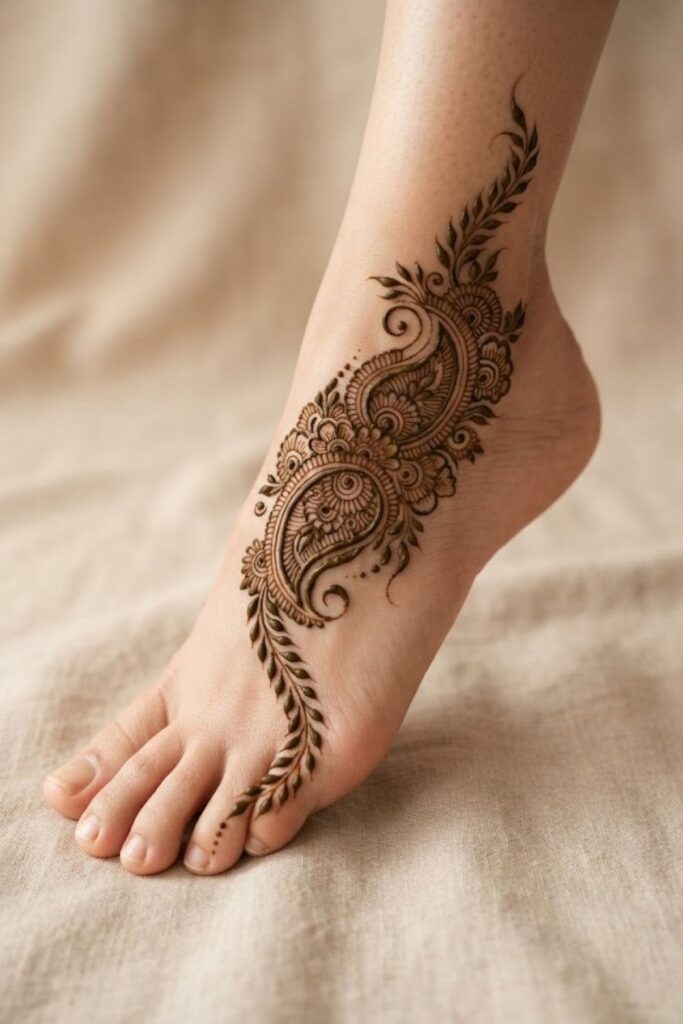
Paisleys are a traditional mehndi element that can easily be adapted for the foot.
Place one medium-sized paisley near the toes and decorate its interior with:
- Small leaves
- Curved lines
- Dots
- Petals
- Fine strokes
A thin vine can then extend from the paisley toward the ankle.
For a modern appearance, use only one or two paisleys instead of filling the entire foot with them.
8. Floral Bracelet Around the Ankle
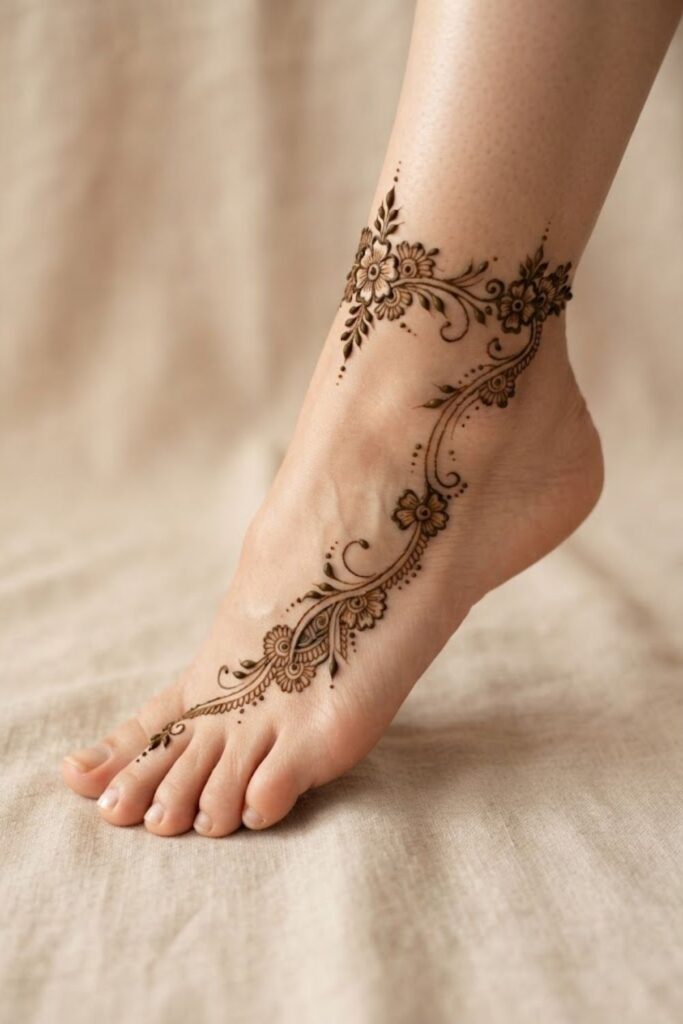
An ankle bracelet can be combined with a one-sided foot trail to create a coordinated look.
The ankle portion can feature tiny flowers connected with a thin curved line.
From one side of the bracelet, allow a leafy vine to travel down toward the foot.
This creates the appearance of a delicate floral chain.
It is particularly attractive for weddings because it gives the feet a more decorative appearance without requiring a filled design.
9. One-Side Foot Mehndi With Toe Details
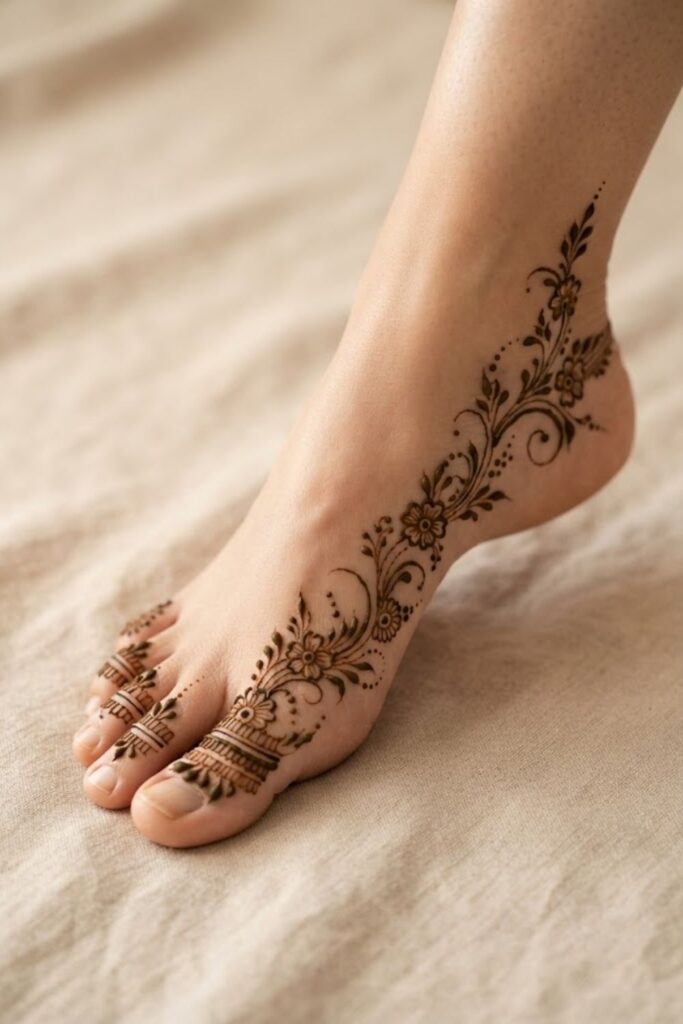
Toe details can make a simple design look much more complete.
You can decorate the big toe with a small flower, while adding thin lines or dots to the neighboring toes.
Keep the remaining toes mostly natural.
Then connect the big-toe design to a side vine.
This creates a subtle transition between the toes and the main foot pattern.
It is an excellent choice for someone who wants simple one-side foot mehndi with a little extra detail.
10. Delicate Floral and Leaf Combination
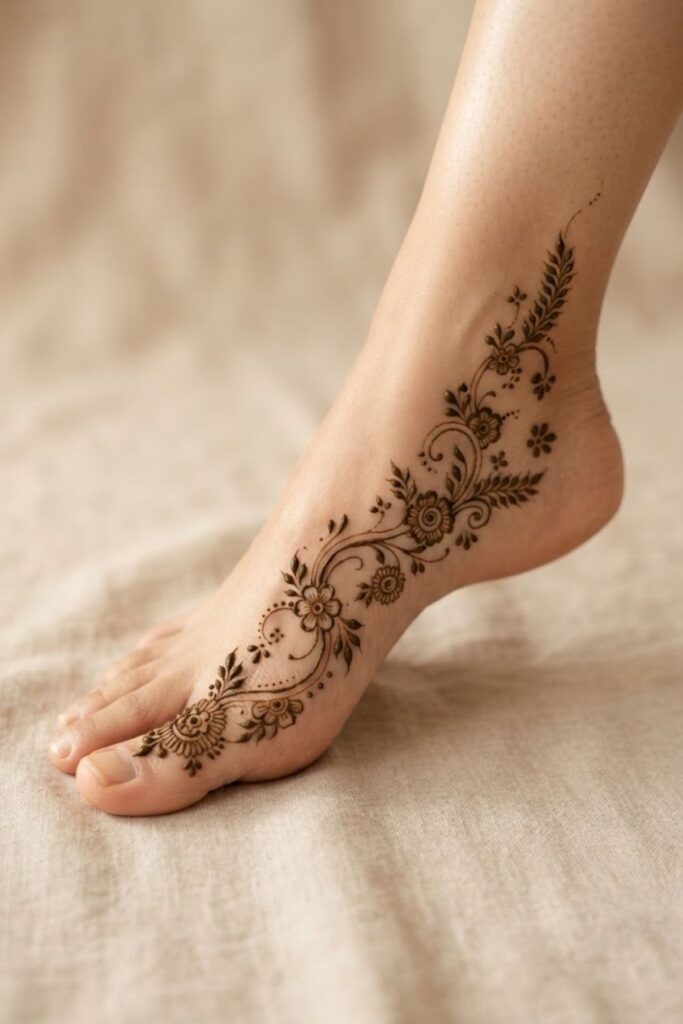
Flowers and leaves are perhaps the most versatile combination in mehndi.
For this design, begin with a small flower close to the outer side of the foot.
Add two large leaves underneath it and a few smaller leaves around the edges.
A thin curved line can connect everything.
Avoid adding too many fillers.
The simplicity of the composition is what makes this style attractive.
11. One-Side Foot Mehndi With Open Spaces
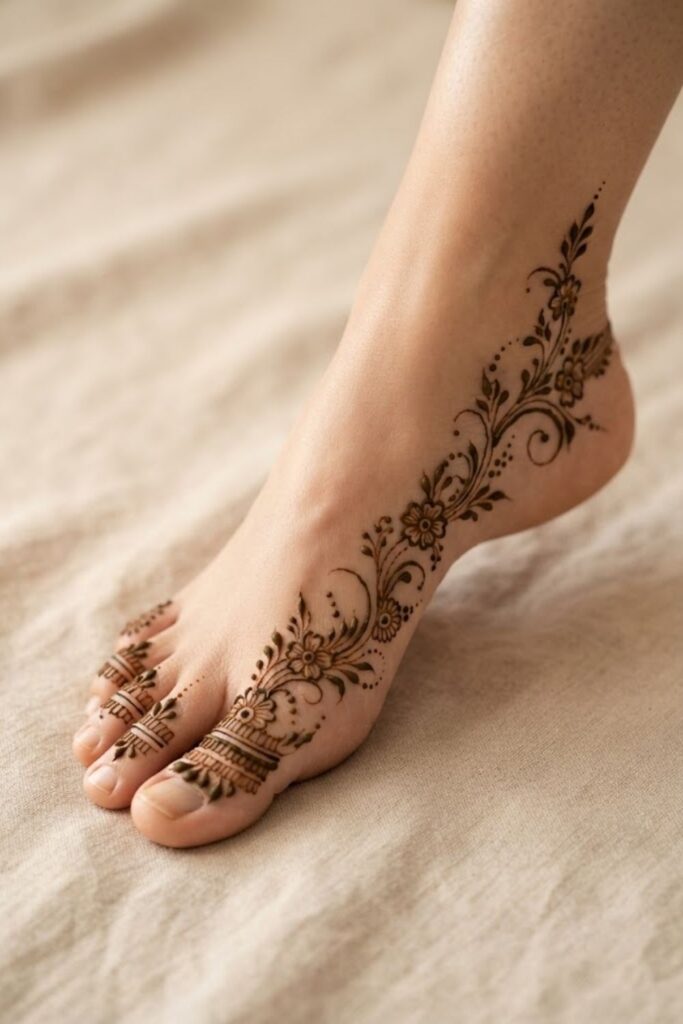
Negative space is especially important in contemporary mehndi.
Instead of filling the spaces between flowers and leaves, deliberately leave them empty.
For example, place three flowers diagonally across one side of the foot. Connect them with a thin vine but leave the opposite side completely untouched.
This gives the design a clean and sophisticated appearance.
It is also a great option for women who do not like heavy mehndi.
12. Easy Arabic Foot Side Design
Beginners can create an Arabic-inspired design without mastering complicated patterns.
Start with:
- One medium flower.
- A curved stem.
- Three or four leaves.
- A few dots.
- One small paisley.
Arrange these elements diagonally.
The most important thing is to maintain a smooth flow.
You do not need complicated shading or dense filling to create attractive Foot One Side Mehndi Designs 2026.
13. One-Side Mandala Inspired Design
A small mandala can be used as the focal point of a one-side foot design.
Instead of placing the mandala directly in the center of the foot, position it slightly toward one side.
Surround it with tiny petals and connect it to a leafy vine.
This creates a combination of traditional mandala detailing and modern open-space styling.
A small mandala is particularly suitable for festive occasions.
14. Curved Vine Foot Mehndi
Sometimes the simplest design can look the most elegant.
Draw a long curved vine starting near the toes and moving toward the ankle.
Add leaves along alternate sides of the vine.
Keep the leaves relatively small and allow plenty of space around them.
You can finish the design with a few dots near the ankle.
This style works especially well with sandals because the design follows the natural shape of the foot.
15. Rose and Leaf One-Side Foot Mehndi
Roses can give a romantic and feminine touch to foot mehndi.
Create one detailed rose as the main focal point and surround it with smaller leaves.
A thin vine can extend toward the ankle.
If you want a more delicate result, use one rose instead of several.
For a wedding, you can make the rose slightly larger and add fine detailing inside the petals.
16. Minimal Side Foot Mehndi for Beginners
Not everyone has advanced mehndi skills.
Fortunately, a beautiful design can be created using only basic elements.
Try this simple pattern:
Small flower → curved line → three leaves → dots → small flower
Place the entire sequence along one side of the foot.
This arrangement is easy to copy and does not require complex filling.
Beginners should concentrate on keeping their lines smooth rather than trying to make the pattern extremely detailed.
17. Bridal One-Side Foot Mehndi
Although bridal mehndi is traditionally detailed, a one-sided bridal design can offer a more modern alternative.
Use larger flowers, paisleys, leafy vines, and detailed fillers along one side of each foot.
The ankle can feature a decorative bracelet-style element.
For a coordinated bridal look, repeat similar motifs on both feet while changing their direction slightly.
This creates a matching but not overly identical appearance.
18. Festive One-Side Foot Mehndi
For festivals such as Eid and other celebrations, you can make your design slightly bolder.
Combine:
- Floral motifs
- Paisleys
- Leaves
- Dots
- Curved lines
- Small geometric fillers
Keep the design concentrated along one side.
This approach gives you a festive appearance without the heaviness of traditional full-foot mehndi.
19. Modern Geometric One-Side Design
If you prefer contemporary mehndi, incorporate small geometric elements.
Triangles, diamonds, curved grids, and simple lines can be combined with flowers.
However, geometric details should complement the floral design rather than dominate it.
A small geometric section near the toes followed by a floral vine can create an interesting modern contrast.
20. Elegant One-Side Foot Mehndi With Ankle Vine
An ankle vine can be the final touch that brings the entire composition together.
Start with a small flower near the outer ankle and allow a thin vine to move down toward the side of the foot.
Add leaves gradually along the trail.
This design is particularly elegant because it follows the natural curves of the foot.
21. Finger-to-Foot Inspired Pattern
A creative option is to borrow the simplicity of finger mehndi and adapt it for the foot.
Use narrow lines, small flowers, tiny leaves, and dots.
Instead of covering the whole foot, keep the design concentrated in one narrow strip.
This creates a delicate appearance similar to minimalist finger mehndi.
22. Bold and Thin Line Combination
Combining line weights can make a simple design look professionally drawn.
Use thicker lines for:
- Main flower outlines
- Large paisleys
- Major leaves
Use thinner lines for:
- Inner petals
- Small leaves
- Dots
- Decorative curves
This contrast adds depth without requiring excessive detailing.
23. One-Side Foot Mehndi for Open Sandals
Your footwear can influence your mehndi placement.
If you are wearing open sandals, place the main design where it will remain visible.
A floral trail along the outer side of the foot can look especially attractive.
Avoid putting all the detailing under areas that will be covered by footwear.
Planning the design according to your shoes can make your overall festive look more coordinated.
24. Matching Both Feet With Different Directions
You do not necessarily have to create identical designs on both feet.
Instead, use the same motifs while changing their direction.
For example:
- Left foot: vine moves from toes toward ankle.
- Right foot: vine moves from ankle toward toes.
Use matching flowers and leaves on both sides.
This creates symmetry while maintaining a natural handmade appearance.
How to Make Your One-Side Foot Mehndi Look More Elegant
Creating a beautiful pattern is not only about the motifs you choose. Placement and spacing are equally important.
Keep the Main Motif Clear
Choose one main focal point.
It could be a flower, paisley, mandala, or floral cluster.
Avoid placing several equally large motifs next to one another because this can make the design look crowded.
Follow the Natural Shape of the Foot
A curved composition usually looks better than a rigid straight line.
Let your vine follow the natural direction of the foot.
Use Different Motif Sizes
Combine large, medium, and small elements.
For example:
Large flower → medium leaf → small flower → tiny dots
This creates visual movement.
Don’t Overfill the Empty Space
Space is part of the design.
You do not need to decorate every visible area.
This is especially important when creating modern Foot One Side Mehndi Designs 2026.
How to Choose Between Simple and Detailed Designs
Your choice should depend on your occasion, outfit, experience, and personal taste.
| Style | Best For | Difficulty |
| Simple Floral | Casual & Eid | Easy |
| Leafy Vine | Minimal Look | Easy |
| Arabic Floral | Festive Events | Medium |
| Paisley Trail | Weddings | Medium |
| Bridal One-Side | Bridal Events | Advanced |
| Geometric Floral | Modern Looks | Medium |
| Toe & Ankle Design | Sandals | Easy |
If you are new to mehndi, start with a simple composition and gradually add details.
A clean, simple pattern will almost always look better than a complicated design with uneven lines.
Tips for Beginners
If you are applying your own foot mehndi, keep the following tips in mind:
Practice First
Draw your design on paper before applying it to your skin.
Start With Pencil-Free Planning
Rather than drawing directly with a pencil on the foot, visualize the main flow of your pattern first.
Begin With Large Motifs
Draw the main flower or paisley first.
Then add leaves and smaller details.
Keep Your Cone Comfortable
Hold the mehndi cone gently.
Excessive pressure can make the lines too thick.
Don’t Rush
Foot mehndi can be slightly challenging because of the shape and movement of the skin.
Take your time.
Let the Design Flow
Do not worry if both feet are not perfectly identical.
Hand-drawn mehndi naturally has small variations, which can make it look more authentic.
How to Apply Foot One Side Mehndi Designs 2026
Choosing a beautiful design is only the first step. The final appearance also depends on how carefully you apply the mehndi. Feet have a different shape and texture than hands, so taking your time can make a noticeable difference.
When applying Foot One Side Mehndi Designs 2026, begin by cleaning the skin properly. Remove dust, lotion, oil, or cream because these can interfere with the henna’s ability to stain the skin evenly.
Once the skin is clean and completely dry, decide where you want your main design to sit.
For a one-side pattern, it is usually best to begin with the largest motif and then build the rest of the design around it.
Step 1: Clean Your Feet
Wash your feet with mild soap and water before applying mehndi.
Avoid applying heavy moisturizer, body oil, or lotion immediately before henna.
Clean skin generally provides a better surface for precise cone work.
Step 2: Plan the Design
Before touching the cone to your skin, decide the direction of your pattern.
Ask yourself:
- Will the design start near the toes?
- Will it move toward the ankle?
- Will the main flower sit on the outer side?
- How much skin do you want to leave open?
- Do you want toe details?
Planning these elements can prevent the design from becoming crowded.
Step 3: Draw the Main Motif
Start with your largest element.
This could be:
- A flower
- A rose
- A paisley
- A mandala
- A floral cluster
Once the main motif is finished, add the supporting elements.
Step 4: Add Leaves and Vines
Use curved lines to connect the main motif with smaller flowers and leaves.
Try not to make the vine completely straight.
A gentle curve generally creates a more natural and elegant appearance.
Step 5: Add Small Details
Once the main structure is complete, add tiny dots, petals, curves, or fine lines.
Do not add fillers simply to fill empty areas.
Remember that negative space is an important part of modern one-side mehndi.
Step 6: Let the Mehndi Dry
Allow the paste to dry naturally.
Avoid rubbing the design against clothing, bedding, or other surfaces while it is still wet.
Patience is especially important if you want a deeper stain.
How to Get a Darker Foot Mehndi Stain
A beautiful design looks even better when the final stain develops into a rich color.
The final shade depends on several factors, including the henna quality, skin chemistry, application technique, and aftercare.
Here are some practical tips.
Use Good-Quality Natural Henna
The quality of the henna paste plays an important role.
Fresh, good-quality natural henna generally provides a better stain than old or poor-quality paste.
Always know what ingredients are being used in your henna.
Keep the Paste on the Skin Longer
Do not remove the dried paste immediately.
Allow it enough time to release its dye into the skin.
Once the paste has completely dried, gently remove it rather than aggressively washing or scrubbing.
Avoid Water Immediately After Removal
Try to avoid washing the area with water immediately after removing the dried paste.
The stain may initially look orange or light.
This is normal.
Natural henna stains usually deepen gradually over the next couple of days.
Keep Your Feet Warm
Warmth can help support the staining process.
However, avoid excessive heat that could irritate or burn the skin.
Comfortable warmth is enough.
Give the Stain Time to Develop
One of the most common mistakes is judging the color immediately after removing the paste.
The initial stain is not the final result.
A fresh natural henna stain can develop from orange into a deeper reddish-brown shade as it oxidizes.
Common Mistakes to Avoid
Even a beautiful design can lose its charm because of a few simple mistakes.
Using Too Much Detail
One-side designs depend heavily on balance.
If you add too many flowers, leaves, dots, and fillers, the design can start looking like a full-foot pattern.
Keep the main composition clear.
Making Every Line the Same Thickness
Different line weights can make your mehndi look more sophisticated.
Use slightly thicker lines for main motifs and finer lines for internal detailing.
Ignoring the Foot Shape
The foot is naturally curved.
A design that looks good on paper may not look equally attractive if it does not follow the shape of the foot.
Try to create flowing lines rather than rigid arrangements.
Filling Every Empty Space
This is one of the biggest mistakes beginners make.
Open areas are not unfinished areas.
They are intentionally part of the composition.
A beautiful Simple One Side Foot Mehndi design often looks attractive precisely because so much natural skin remains visible.
Applying Lotion Before Mehndi
Oily or heavily moisturized skin can make cone application more difficult.
Clean and dry your skin before starting.
Removing the Paste Too Quickly
Removing henna before it has had enough time to stain can result in a weaker color.
Give it adequate time and avoid rushing the process.
Foot Mehndi Aftercare Tips
After applying Foot One Side Mehndi Designs 2026, proper aftercare can help protect the design while the stain develops.
Keep the Area Dry Initially
Try to minimize unnecessary contact with water immediately after removing the paste.
Avoid Scrubbing
Do not exfoliate the feet while the stain is developing.
Scrubbing can cause the color to fade faster.
Avoid Strong Chemicals
Products containing strong chemicals may affect the appearance and longevity of the stain.
Moisturize Later
Once the stain has developed, keeping the skin moisturized can help maintain smooth-looking skin and make the mehndi appear more polished.
Protect Your Design
Tight footwear can rub against fresh mehndi.
If possible, choose comfortable footwear that does not repeatedly scrape the decorated area.
How Long Does Foot Mehndi Usually Last?
The longevity of mehndi depends on several factors.
These include:
- Quality of henna
- Skin type
- How often you wash your feet
- Exposure to water
- Exfoliation
- Footwear friction
- Individual skin renewal
Foot mehndi may gradually fade as the outer layer of skin naturally sheds.
Designs with thicker application may sometimes remain visible longer than extremely fine patterns, but the exact duration varies from person to person.
Foot One Side Mehndi Designs for Different Personalities
One of the best things about this trend is that the design can reflect your personality.
For Minimalist Girls
Choose a small flower, leafy vine, or delicate curved line.
Keep most of the foot uncovered.
For Floral Lovers
Choose roses, lotus-inspired flowers, petals, and leafy trails.
A floral composition can look feminine without becoming heavy.
For Arabic Mehndi Lovers
Choose bold flowers, curved vines, paisleys, and open spaces.
Arabic one-side foot mehndi is particularly suitable for women who want a stylish traditional look.
For Brides
Choose a more detailed floral trail with ankle decoration, paisleys, and fine fillers.
You can also coordinate the foot design with your hand mehndi.
For Beginners
Start with simple flowers, leaves, dots, and curved lines.
Do not attempt an extremely detailed bridal design until you are comfortable controlling the cone.
How to Match Foot Mehndi With Your Outfit
Your outfit and footwear can influence which design looks best.
With a heavily embroidered dress, a relatively simple foot pattern can provide balance.
With a simple outfit, you can choose a more detailed floral or Arabic pattern.
For open sandals, place the design where it remains visible.
For traditional wedding footwear, an ankle-and-foot combination can create a more decorative appearance.
The goal is to make your mehndi complement your overall look rather than compete with it.
Frequently Asked Questions About Foot One Side Mehndi Designs 2026
What are Foot One Side Mehndi Designs 2026?
Foot One Side Mehndi Designs 2026 are modern foot henna patterns that concentrate the decoration mainly along one side of the foot. They commonly feature flowers, leaves, vines, paisleys, dots, and Arabic-inspired motifs while leaving part of the foot uncovered.
Is one-side foot mehndi suitable for beginners?
Yes. Simple one-side designs are often easier for beginners because they require less coverage than full-foot mehndi. Start with basic flowers, leaves, dots, and curved vines before trying complicated patterns.
What is the difference between full-foot and one-side foot mehndi?
Full-foot mehndi generally covers a larger portion of the foot with detailed patterns. One-side foot mehndi focuses the design along one edge or direction, creating more open space and a lighter appearance.
Is Arabic one-side foot mehndi popular in 2026?
Yes, Arabic-inspired patterns remain a popular style because their flowing vines, bold floral motifs, and open spaces work naturally with the one-side concept.
Can I use one-side foot mehndi for a wedding?
Absolutely. You can make the design more detailed for a wedding by adding flowers, paisleys, fine fillers, and ankle decoration.
What is the easiest simple one-side foot mehndi design?
A leafy vine is one of the easiest choices. You can draw a curved line along one side of the foot and add small leaves, flowers, and dots.
How can I make my foot mehndi look elegant?
Focus on clean lines, balanced spacing, and a clear focal point. Avoid filling every empty area. Open spaces can make your design look more modern and sophisticated.
Can I combine toe mehndi with a one-side foot design?
Yes. Small toe details can be connected to a side floral or leafy trail. This creates a coordinated look without covering the complete foot.
How long should I keep henna on my feet?
The ideal duration can vary depending on the henna paste and the desired stain. In general, allow the paste to dry and remain on the skin for sufficient time rather than removing it immediately.
Why does my henna look orange at first?
Fresh natural henna commonly appears orange immediately after the paste is removed. The stain can deepen gradually as it oxidizes over the following hours and days.
Can I wear sandals with foot mehndi?
Yes. In fact, open sandals can beautifully showcase a one-side foot design. Consider placing the main pattern where it will remain visible with your chosen footwear.
Are one-side foot designs good for Eid?
Yes. A simple floral, leafy, or Arabic-inspired pattern can be an excellent choice for Eid because it provides a festive appearance without requiring heavy full-foot coverage.
How do I choose the best foot mehndi design?
Consider your occasion, outfit, footwear, mehndi skill level, and personal preference. Minimal designs work well for casual occasions, while detailed floral and Arabic patterns are suitable for weddings and festive events.
Final Thoughts on Foot One Side Mehndi Designs 2026
Foot One Side Mehndi Designs 2026 offer a beautiful combination of traditional henna artistry and modern minimalism. Instead of covering the complete foot, these designs use carefully placed flowers, leaves, vines, paisleys, and decorative details to create an elegant visual flow.
From a tiny floral pattern for everyday wear to a detailed Arabic design for a wedding, there is an option for almost everyone.
The biggest advantage of this style is its flexibility. You can keep the design extremely simple or add more detail depending on the occasion.
If you are a beginner, start with a leafy vine or small floral trail. If you are experienced with henna, experiment with Arabic flowers, paisleys, ankle vines, and delicate fillers.
Remember that a beautiful design does not have to be complicated. Good spacing, clean lines, balanced motifs, and intentional open areas can make even a simple pattern look stunning.
At Mehndi Crafted, our goal is to provide easy-to-follow inspiration for anyone who loves mehndi and wants to discover new styles. Whether you are preparing for Eid, a wedding, an engagement, or simply want to try something beautiful, one-side foot mehndi is a timeless option worth exploring.
Choose a design that matches your personality, take your time while applying it, and allow the stain to develop naturally.
With the right pattern and careful application, your feet can become a beautiful part of your overall mehndi look.
Explore more mehndi inspiration on Mehndi Crafted and discover your next favorite design.