Indian Floral Mehndi Designs 2026 are becoming a beautiful choice for women who love the charm of flowers, delicate leaves, and traditional henna artistry. Floral patterns can look soft and minimal on one hand, or detailed and festive when combined with paisleys, vines, mandalas, and fine finger work. Their versatility makes them suitable for weddings, festivals, family celebrations, and everyday beauty.
From a tiny flower near the wrist to a full-hand arrangement inspired by Indian gardens, floral mehndi offers countless ways to express personal style. Some designs are perfect for beginners, while others create a rich bridal appearance with layered petals, shaded leaves, and elegant patterns.
At Mehndi Crafted, we love exploring designs that combine traditional beauty with modern simplicity. This guide features 25 floral ideas, styling tips, placement suggestions, and helpful answers for choosing a design that suits your occasion.
Why Floral Mehndi Designs Remain Popular
Flowers have always been an important part of Indian decorative art. They appear in celebrations, clothing, jewellery, rangoli, and wedding décor. Floral mehndi brings that same natural beauty to the hands and feet.
One reason floral patterns remain popular is their flexibility. A flower can be drawn as a simple outline, filled with fine lines, shaded with henna, or surrounded by leaves and vines. The same basic motif can therefore create a completely different look depending on the artist’s technique.
Floral designs also work well with many other mehndi styles. A rose can be paired with Arabic vines, a lotus can become part of a mandala, and tiny flowers can connect fingers like delicate jewellery. This makes floral mehndi suitable for both traditional and contemporary preferences.
Another advantage is that floral patterns can be adjusted to different skill levels. Beginners may choose open flowers and small leaves, while experienced artists can explore layered petals, fine shading, and detailed compositions.
25 Indian Floral Mehndi Designs 2026 to Try
The following ideas include simple, elegant, traditional, and festive floral patterns. You can use them as inspiration for your next mehndi appointment or practice session.
1. Simple Flower Center Mehndi Design
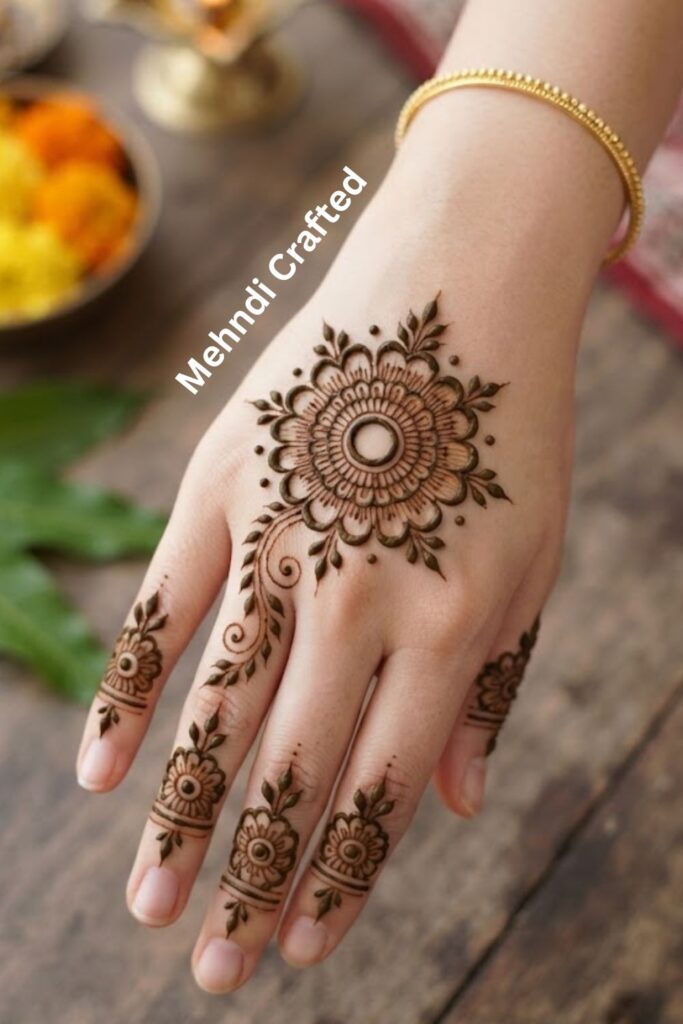
A simple flower placed in the center of the palm creates a clean and balanced appearance. The flower can feature five or six rounded petals with a small dot or circle in the middle.
To make the design more interesting, add two tiny leaves on opposite sides. Keep the surrounding palm open so the flower remains the main focus.
This style is ideal for casual gatherings, school events, small celebrations, or anyone who prefers minimal mehndi. It is also easy to recreate because the pattern does not require complicated fillings.
For a softer appearance, use thin outlines and leave the petals partially open. For a bolder look, fill the center with henna and add small dots around the flower.
2. Floral Bail Along the Side of the Hand
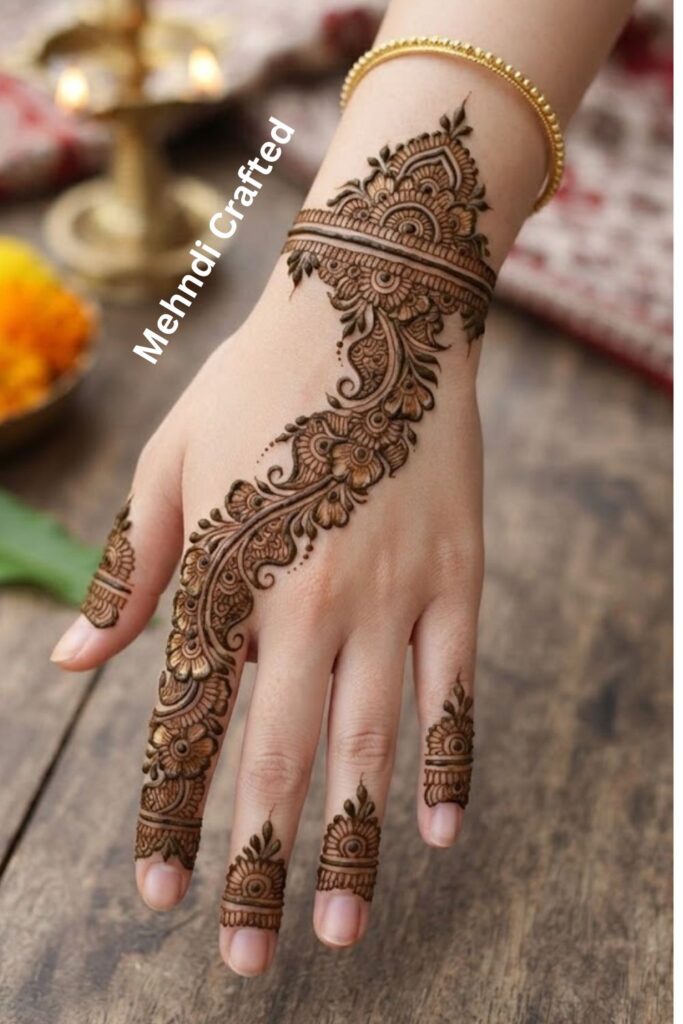
A floral bail is one of the most graceful ways to decorate the hand. It usually begins near the wrist and travels diagonally toward the fingers or across one side of the palm.
For this design, create a flowing vine with small leaves and flowers placed at different points. Avoid making every flower identical; slight variations make the pattern feel more natural.
A side-hand floral bail is especially suitable for people who like negative space. The open areas allow the design to look light without appearing unfinished.
You can also connect the bail to one finger with a thin line, creating a delicate jewellery-inspired effect.
3. Traditional Indian Flower Mehndi Design
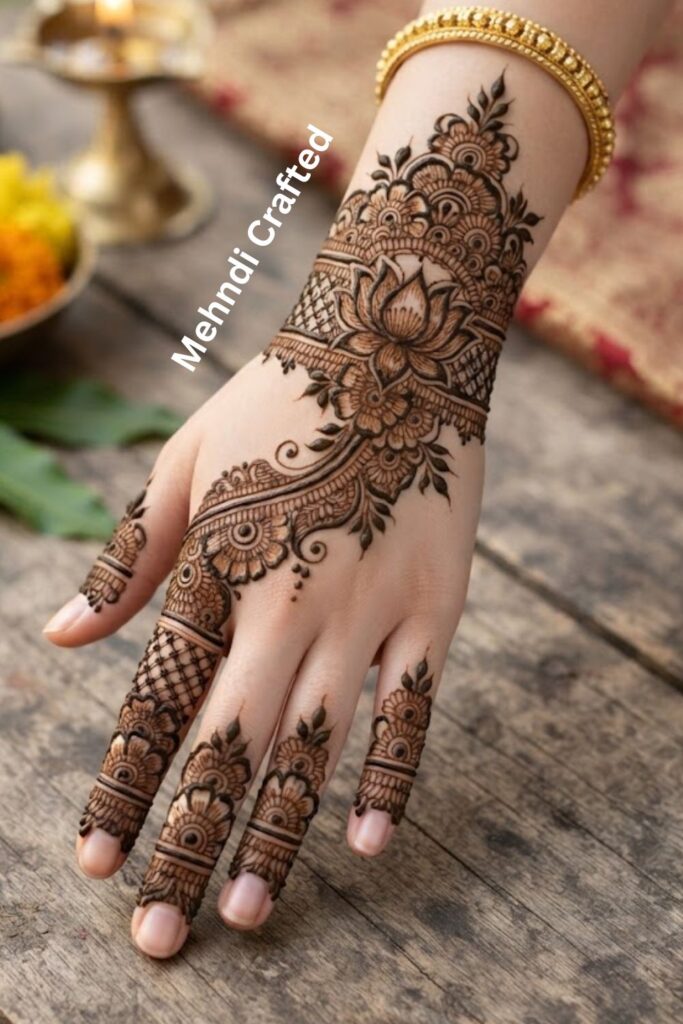
A Traditional Indian Flower Mehndi Design often includes detailed petals, curved leaves, paisleys, dots, and decorative fillers. It may cover a larger portion of the palm while maintaining a balanced arrangement.
Traditional floral patterns can be inspired by lotus flowers, roses, marigolds, or imaginary garden motifs. The flowers are often surrounded by fine lines and small ornamental details.
For a classic Indian appearance, combine a central flower with paisleys on either side. Add tiny dots around the edges to create a finished look.
This style is suitable for weddings, religious celebrations, family functions, and festive occasions where a more traditional design is preferred.
4. Minimal Floral Finger Mehndi
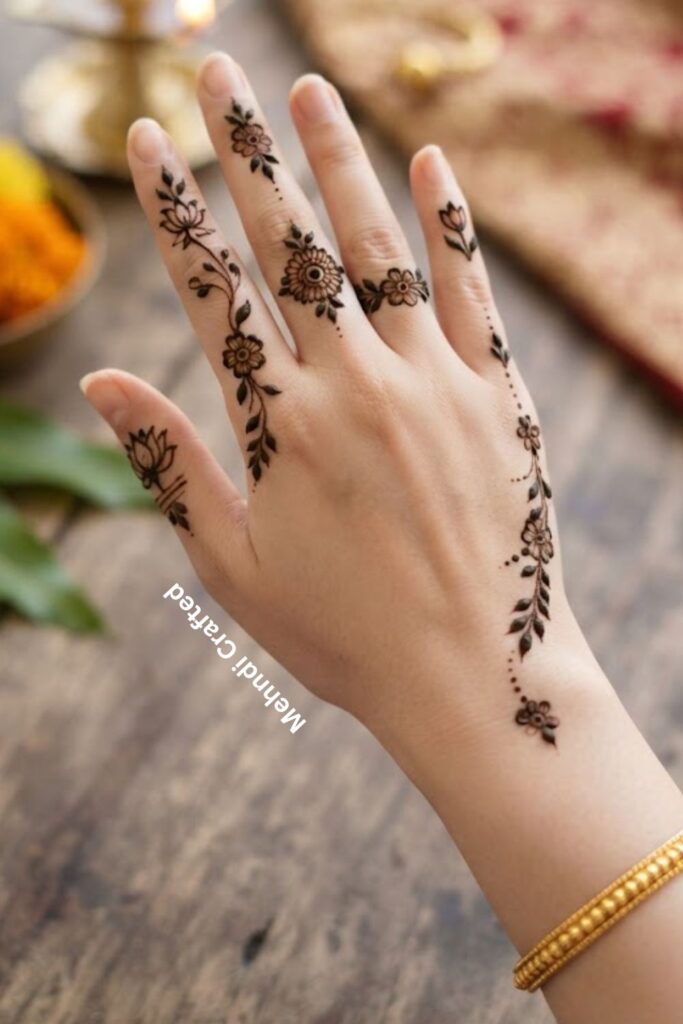
Finger mehndi does not always need to cover the entire hand. A small flower placed on one finger can create a modern and stylish result.
Try drawing a tiny flower near the middle or upper section of the finger. Add a short leafy line below it, leaving the rest of the finger uncovered.
This is one of the easiest options for beginners because the design uses limited space and simple shapes. It also works well for people who want a subtle mehndi look without a full-hand pattern.
For a coordinated appearance, place a similar small flower on the opposite hand or add a tiny dot near the wrist.
5. Floral Bracelet Mehndi
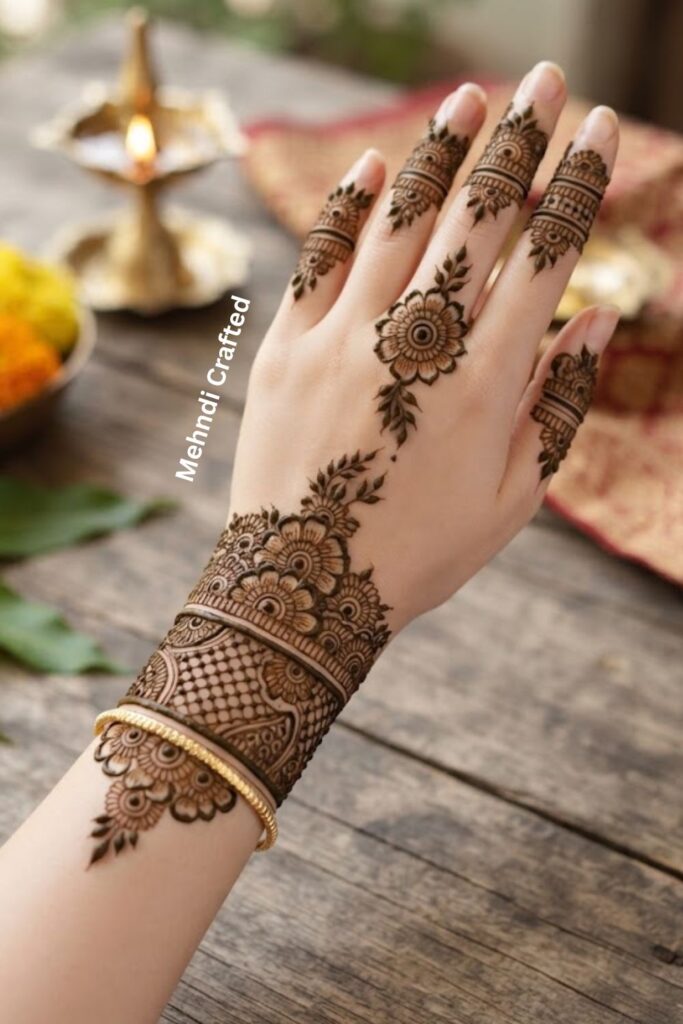
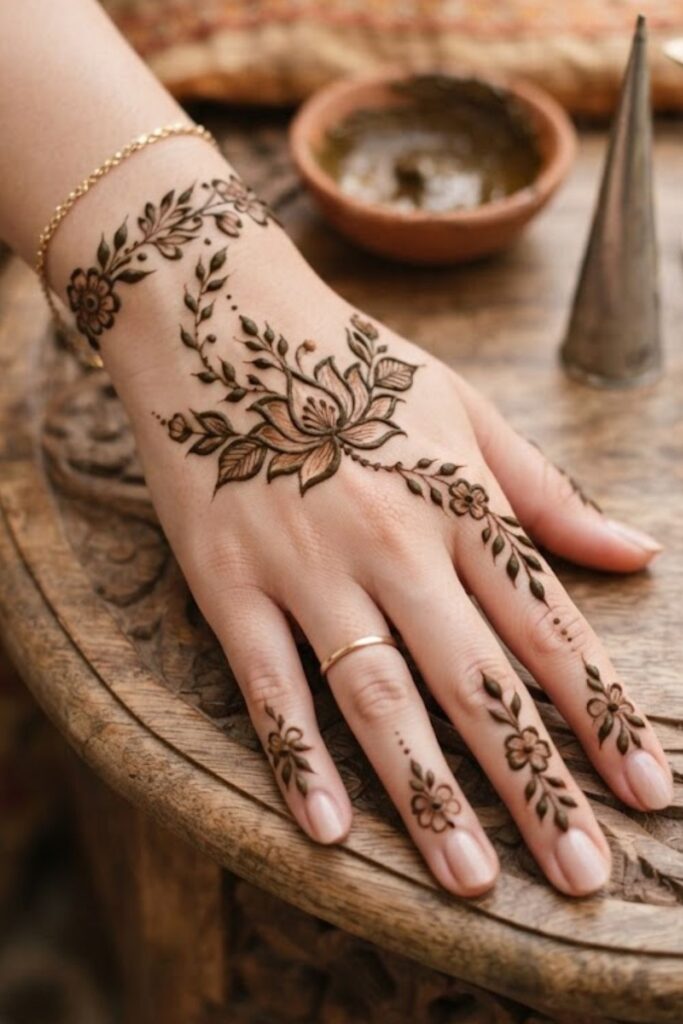
A floral bracelet design wraps around the wrist like a decorative bangle. It can be made with a single vine, a row of flowers, or a combination of leaves and dots.
To create this pattern, begin with a curved line around the wrist. Add small flowers at regular intervals and connect them with leafy stems.
A floral bracelet looks beautiful when the palm is left mostly open. You can also extend one vine slightly toward the back of the hand for a more connected appearance.
This design is perfect for festive outfits, simple jewellery styling, and occasions where you want your mehndi to resemble a delicate accessory.
6. Lotus-Inspired Floral Mehndi
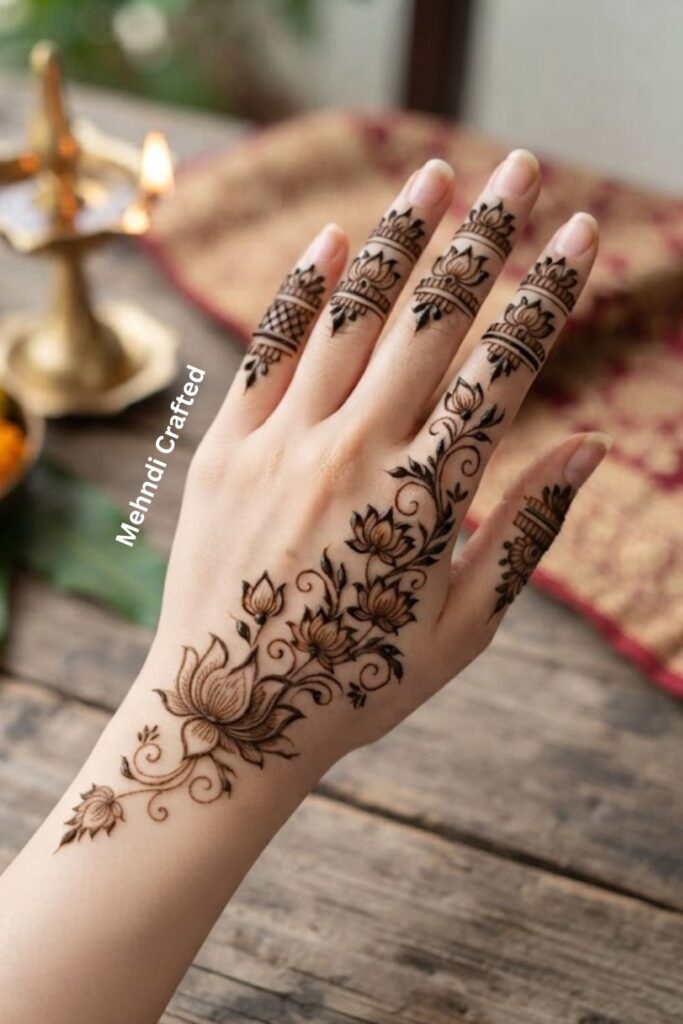
The lotus is a popular motif in Indian art and can add a graceful, symbolic touch to mehndi. A lotus-inspired design may feature an open flower with layered petals and curved leaves.
Place the lotus in the center of the palm or near the wrist. Surround it with small dots, curved lines, or a few leafy branches.
For a minimal version, draw only the outline of the lotus and leave the petals open. For a traditional version, add fine interior lines and decorative fillers.
This design can look especially beautiful when paired with a simple mandala or a small paisley.
7. Floral Mandala Mehndi
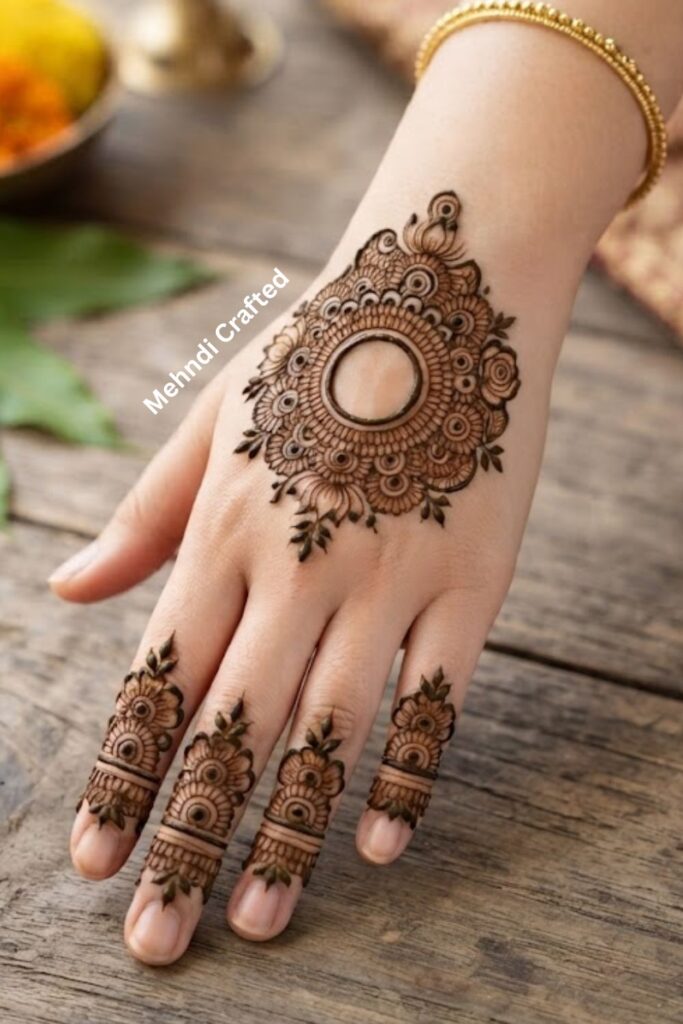
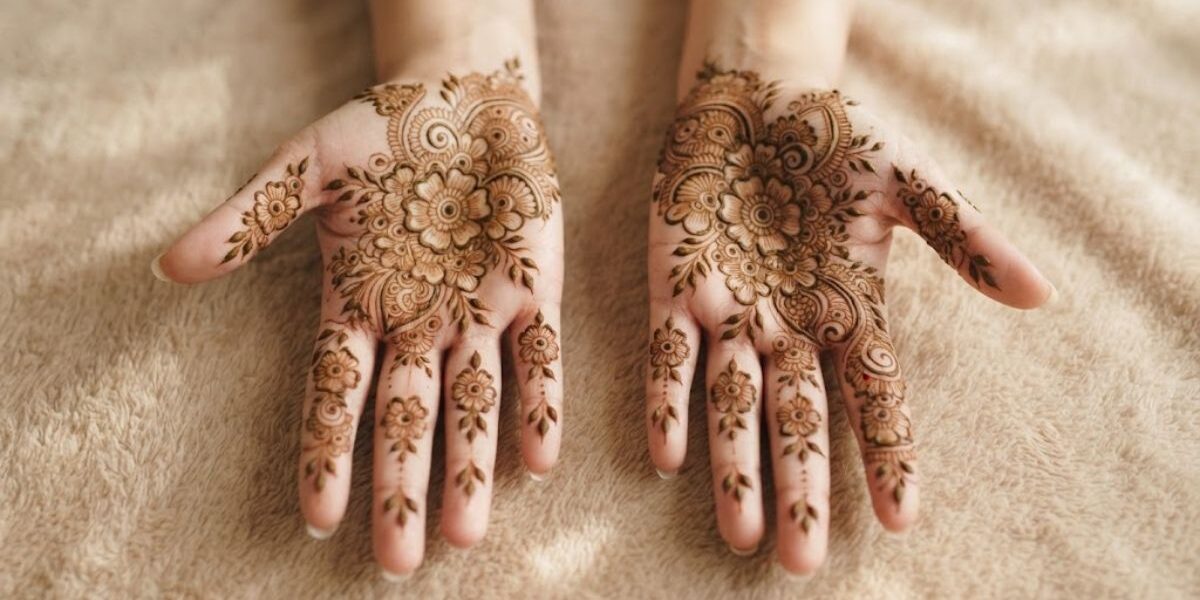
A floral mandala combines the circular balance of a mandala with the softness of flower petals. It is usually placed in the center of the palm.
Start with a small circle, then build outward using petals, curved lines, and tiny dots. Keep each layer evenly spaced for a neat appearance.
A floral mandala can be simple or detailed. Beginners can use two or three layers, while experienced artists can add multiple petal shapes and fine fillers.
This design is suitable for festivals, weddings, and anyone who enjoys symmetrical mehndi patterns.
8. Open-Space Floral Back-Hand Design
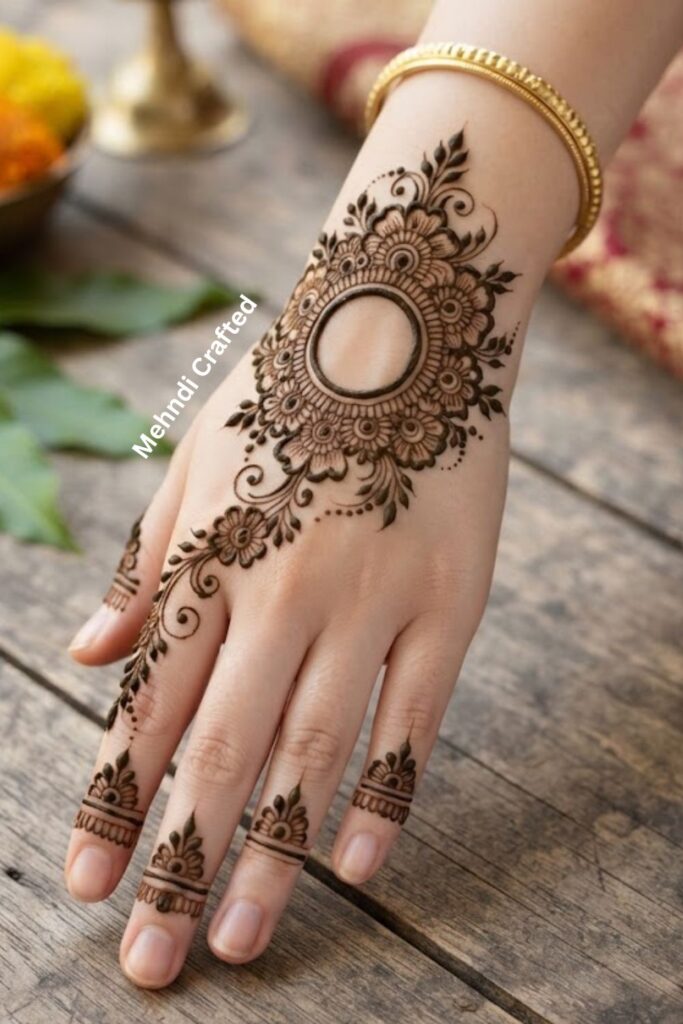
Back-hand floral mehndi looks elegant when the flowers are arranged with enough open space between them. Instead of filling the entire hand, use a few connected motifs.
Begin near the wrist with a flower and allow a leafy vine to travel toward the index finger. Add one or two smaller flowers along the path.
The open areas make the design appear modern and lightweight. This is also a practical choice for people who want their mehndi to remain visible without feeling too dense.
You can explore more ideas in our guide to Back Hand Mehndi Designs.
9. Floral Chain Connecting the Fingers
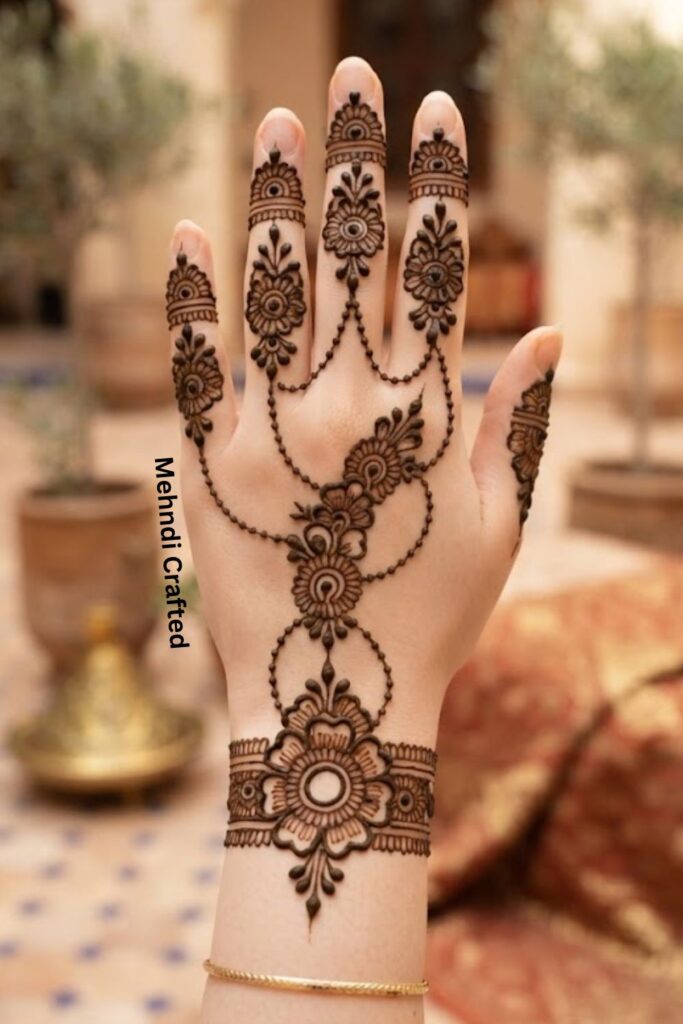
A floral finger chain creates a jewellery-like appearance by connecting small flowers across the fingers. The design can be placed on one finger or extended across two or three.
Use tiny flowers, short curved lines, and small leaves to form the chain. Keep the motifs delicate so the fingers do not look overcrowded.
This style is ideal for engagement parties, festive gatherings, and modern outfits. It also works well with rings and bracelets because the design resembles a fine henna accessory.
10. Rose and Leaf Mehndi Design
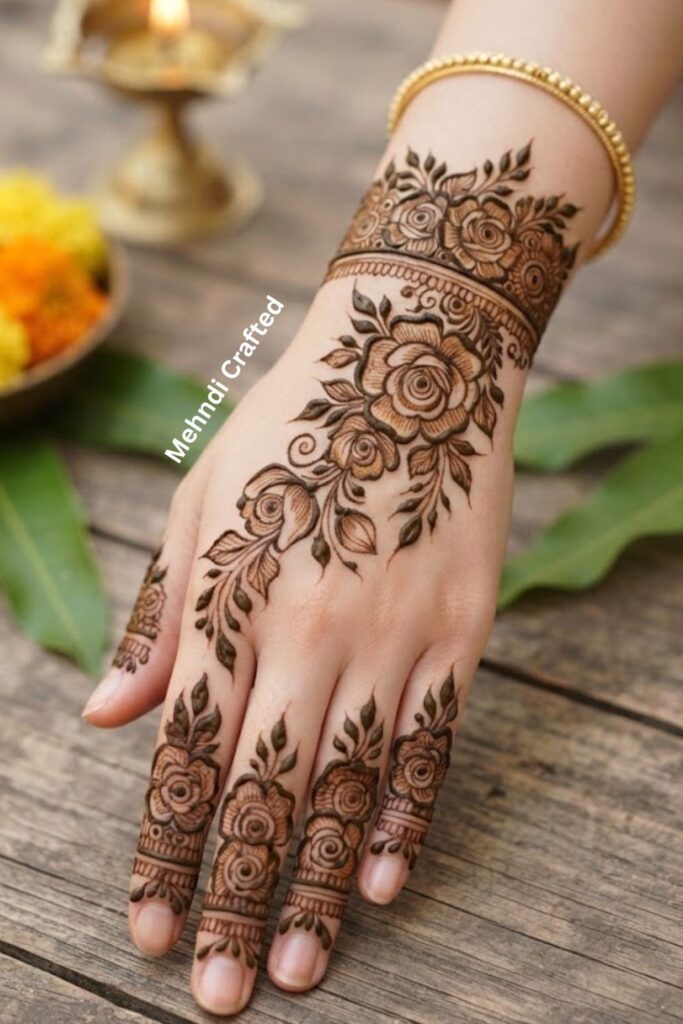
Roses bring a romantic and decorative feel to floral mehndi. A rose can be drawn with curved overlapping petals, while leaves provide contrast and movement.
Place one medium-sized rose near the wrist or side of the palm. Add a few leaves around it and connect the elements with a thin vine.
For a simple design, use only one rose. For a more detailed pattern, combine several small roses with paisleys and fine lines.
Rose mehndi is a lovely choice for weddings, anniversaries, and special occasions.
11. Simple Indian Floral Mehndi Designs With Tiny Flowers
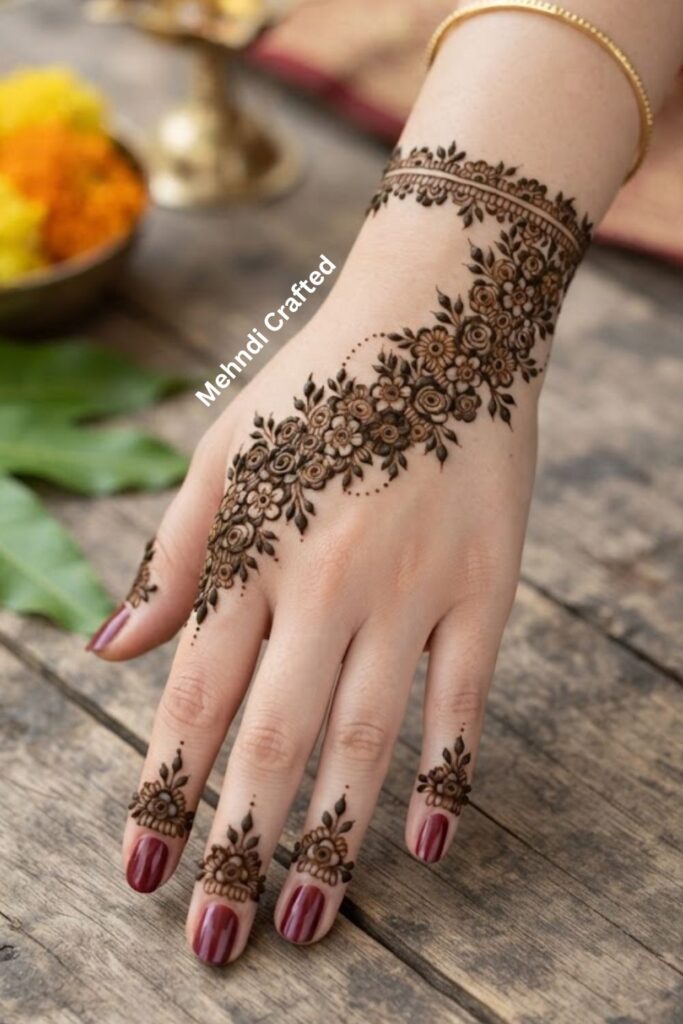
Simple Indian Floral Mehndi Designs often rely on small flowers rather than large, detailed motifs. These designs are easy to wear and can be adapted to almost any hand shape.
Create a thin vine across the palm and add tiny flowers at different points. Leave some space between the motifs to keep the pattern airy.
You can place the vine diagonally, vertically, or along the outer edge of the hand. Each arrangement creates a slightly different appearance.
This style is especially suitable for beginners, college students, casual celebrations, and people who prefer quick mehndi applications.
12. Floral Paisley Combination
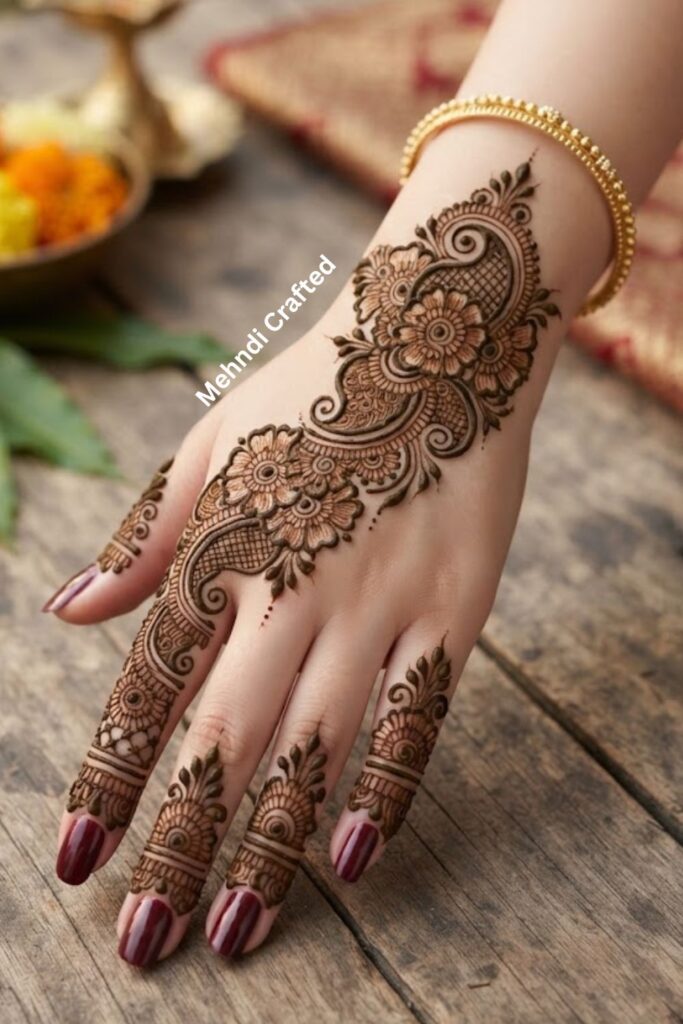
Combining flowers with paisleys creates a traditional yet versatile mehndi design. The paisley provides structure, while the flowers soften the overall appearance.
Place a medium-sized paisley on the palm and add a flower near its curved edge. Use leaves and dots to connect the two motifs.
You can keep the paisley open for a modern look or fill it with fine lines and small petals for a richer traditional effect.
This combination works beautifully for both front-hand and back-hand designs.
13. Half-Hand Floral Mehndi
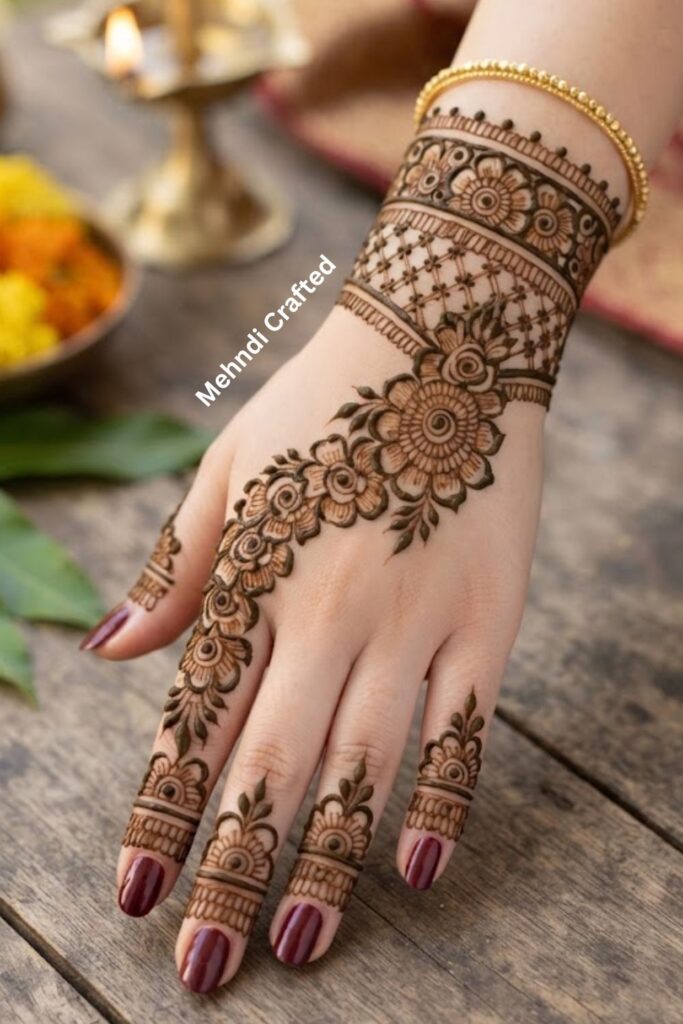
A half-hand floral design decorates only one section of the palm or back of the hand. It is ideal for people who want a noticeable design without full coverage.
Try placing a large flower near the wrist and extending a leafy vine toward the center of the palm. Leave the upper portion open.
This arrangement creates a balanced composition and allows the flower to stand out. It is also a useful option when you have limited time for mehndi application.
14. Floral Vine With Curved Leaves
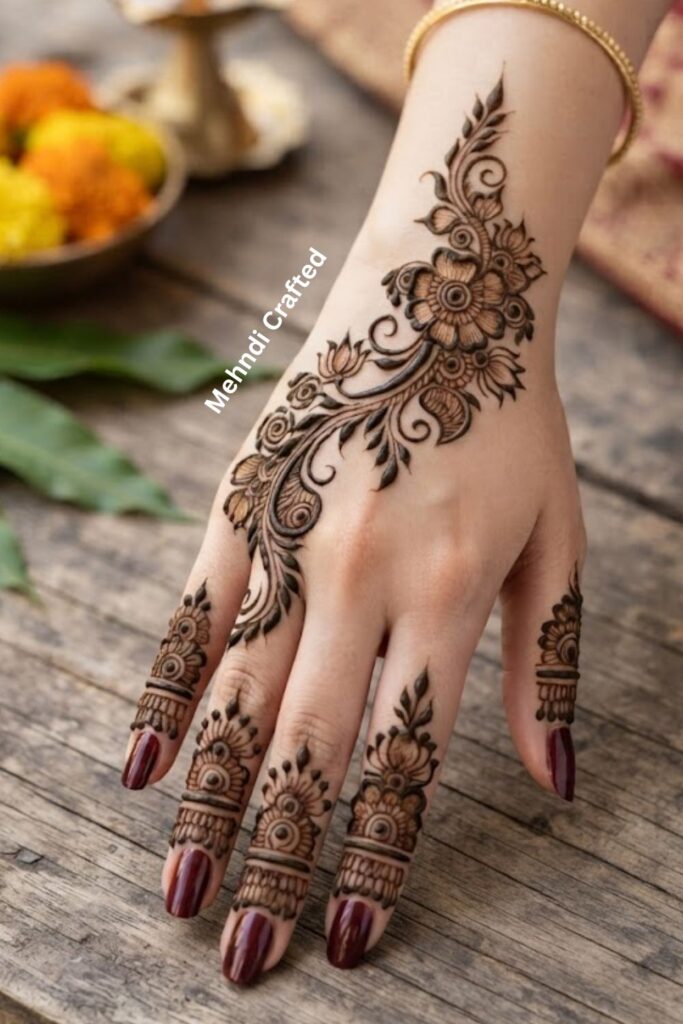
A floral vine becomes more attractive when the leaves follow the natural direction of the stem. Curved leaves can make the design look fluid and graceful.
Start with a long, slightly curved line. Add flowers at different intervals, then place leaves along the empty spaces.
Avoid arranging every leaf at the same angle. A natural variation creates a more artistic appearance.
This design can be placed along the wrist, side of the palm, forearm, or back of the hand.
15. Bridal Floral Mehndi With Detailed Petals
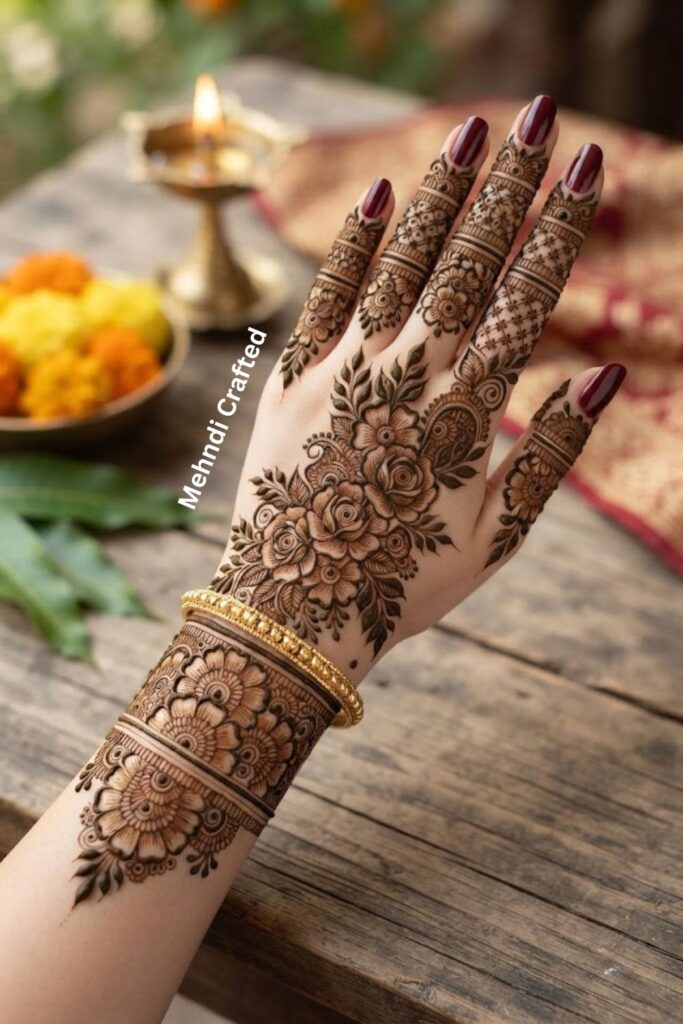
Bridal floral mehndi can combine large flowers, layered petals, paisleys, leafy vines, and fine fillers. The design usually covers more of the hand and creates a richer visual effect.
For a bridal arrangement, begin with one main flower and build supporting motifs around it. Use detailed petals, small dots, and curved lines to fill the spaces without making the pattern look crowded.
A bridal floral design can be paired with traditional Indian elements such as mandalas, peacocks, jaalis, and paisleys.
If you are planning a wedding look, explore our collection of Bridal Mehndi Designs for more inspiration.
16. Floral Mehndi With Negative Space
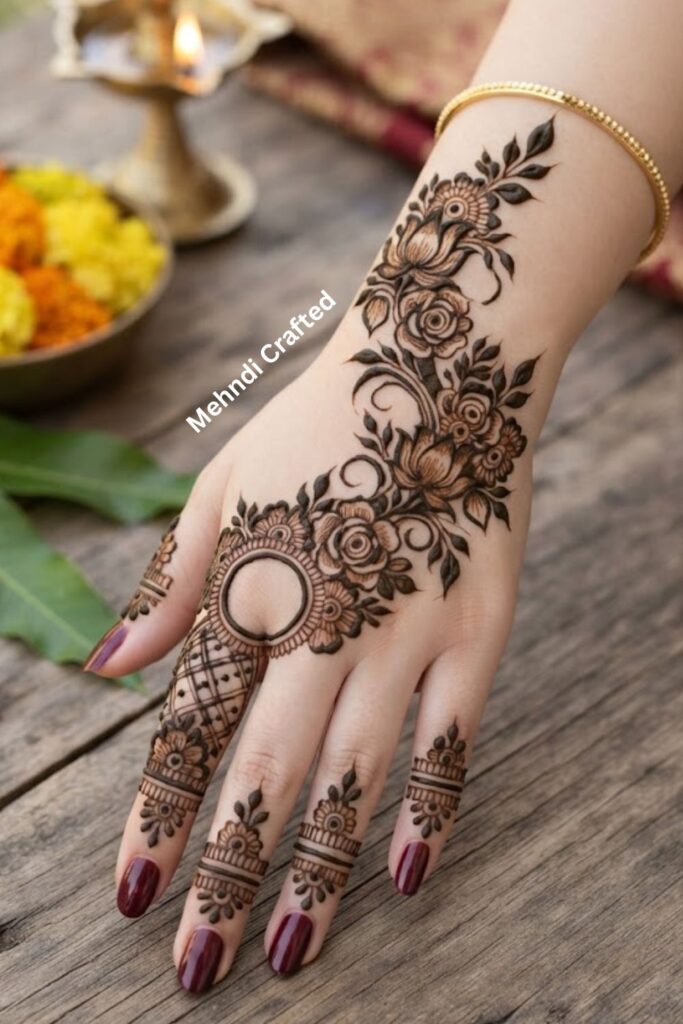
Negative space means leaving selected areas of the hand free from henna. This technique allows the design to look clean, modern, and visually balanced.
For a floral negative-space pattern, place flowers along one side of the palm and leave the opposite side open. Add a few leaves or dots to connect the composition.
This style is particularly popular among people who like contemporary mehndi. It also photographs beautifully because the contrast between the henna and skin makes the motifs easy to see.
17. Floral Wrist-to-Finger Trail
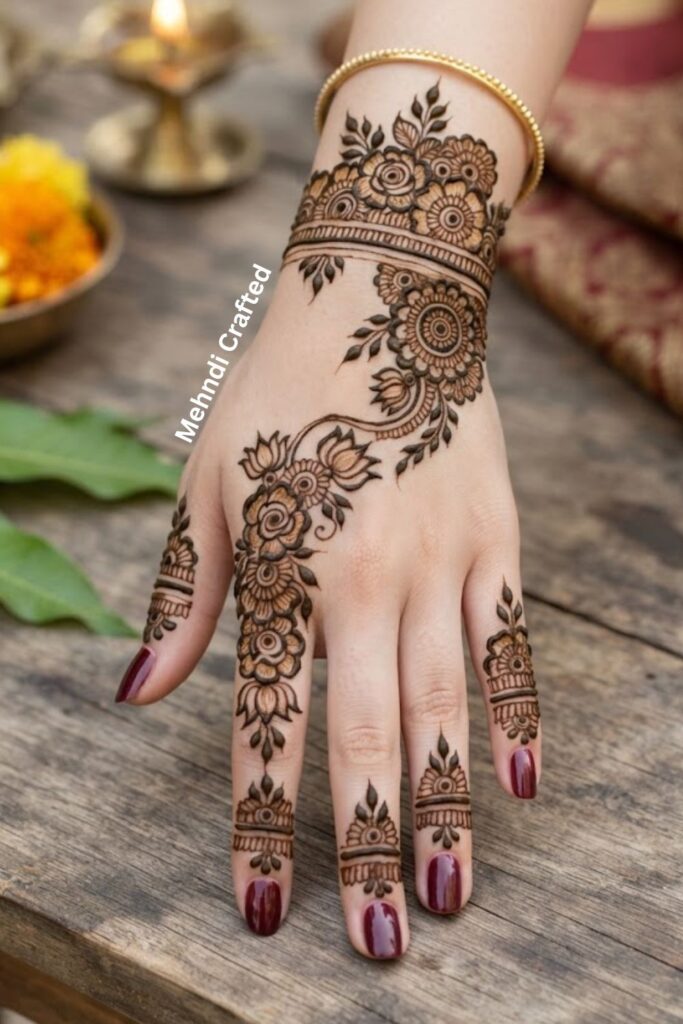
A wrist-to-finger trail creates a long, connected design that travels across the hand. It can begin with a flower near the wrist and end with a tiny motif near one finger.
Use a curved vine as the foundation. Add flowers, leaves, and small dots along the trail.
The design should gradually become lighter as it approaches the finger. This creates a natural flow and prevents the hand from looking too heavy.
It is a beautiful choice for parties, festivals, and semi-formal celebrations.
18. Floral Mehndi With Geometric Details
For a modern twist, combine flowers with geometric shapes such as diamonds, grids, triangles, or neat lines.
Place a flower in the center and surround it with a simple geometric border. Add small leaves outside the border to soften the structure.
This combination is ideal for people who enjoy both traditional motifs and contemporary patterns.
The key is to maintain balance. Too many geometric details can overpower the flowers, so use them as supporting elements.
19. Floral Arabic-Style Mehndi
Arabic-inspired floral mehndi often features bold flowers, flowing vines, and open spaces. Compared with dense traditional patterns, it usually has a more spacious arrangement.
Begin with a large flower near the wrist or side of the palm. Extend a vine diagonally and add leaves along its length.
Keep the flowers slightly larger and the lines clear. This helps the design remain visible and attractive after the henna dries.
Arabic floral mehndi is suitable for Eid, parties, dinners, and casual festive occasions.
20. Floral Mehndi for Beginners
Beginners can start with a simple flower, two leaves, and a short curved line. This small composition is enough to create a complete-looking design.
Practice drawing petals of similar size and keep the center of the flower neat. Once the basic shape feels comfortable, add small dots or a second flower.
Do not worry about making every line perfect. Consistent practice improves control, spacing, and confidence.
A beginner-friendly floral design can be placed on the wrist, finger, side of the hand, or back of the palm.
21. Floral Mehndi With Dotted Fillers
Dots are among the easiest ways to enhance a floral design. They can fill empty spaces, outline a motif, or create a soft transition between flowers and leaves.
For this design, use a few medium-sized flowers and connect them with thin vines. Add dotted fillers around the outer edges.
Keep the dots varied in size for a more natural appearance. Avoid placing too many dots in one area, as this may make the pattern look crowded.
This technique is useful for both simple and detailed mehndi styles.
22. Peacock and Floral Combination
Peacock motifs are often associated with Indian mehndi traditions and can be combined beautifully with flowers.
Place a small peacock on one side of the palm and add flowers around its body or tail. Use leaves and curved lines to connect the motifs.
For a simple version, use only the peacock outline and a few flowers. For a bridal version, add detailed feathers, paisleys, and decorative fillers.
This combination is especially suitable for weddings and cultural celebrations.
23. Floral Mehndi With Jewellery-Inspired Details
Jewellery-inspired floral mehndi can include chains, bracelets, rings, and small hanging motifs. The flowers become part of the jewellery-like structure.
Create a floral bracelet around the wrist and connect it to a finger using a thin line. Add a small flower near the finger joint to complete the look.
This style works well with traditional jewellery because the henna design complements rather than competes with accessories.
It is also a beautiful choice for engagement ceremonies and festive outfits.
24. One-Sided Floral Palm Design
A one-sided floral palm design places the main decoration along one edge of the hand. The center and opposite side remain mostly open.
Start with a large flower near the lower palm. Add a vine that curves upward toward the fingers, then decorate it with leaves and tiny buds.
This design is simple, elegant, and easy to customize. You can make it more traditional by adding paisleys or more modern by keeping the lines minimal.
25. Full-Hand Floral Mehndi With Balanced Coverage
A full-hand floral design combines several motifs while maintaining a clear visual structure. It may include flowers, leaves, paisleys, mandalas, and small fillers.
To create a balanced full-hand pattern, choose one main motif and repeat smaller elements around it. Avoid making every section equally dense.
Use open spaces between major flowers so the design remains readable. Fine lines and small dots can fill selected gaps without overwhelming the composition.
This style is ideal for brides, wedding guests, and major festive celebrations.
How to Choose the Right Floral Mehndi Design
Choosing a floral design depends on your occasion, outfit, available time, and personal preference. A simple pattern may be more suitable for a casual event, while a detailed floral arrangement can complement bridal clothing.
Consider the Occasion
For everyday wear or small gatherings, choose a minimal flower, floral bracelet, or simple vine. For weddings and festivals, you can explore detailed petals, paisleys, mandalas, and traditional fillers.
Think About Your Outfit
Floral mehndi pairs well with many clothing styles. Light floral patterns complement pastel outfits, while bold traditional designs look beautiful with richly embroidered dresses.
If your outfit already has heavy embroidery, an open floral design may create a more balanced appearance. If your clothing is simple, a detailed floral mehndi pattern can become the main decorative element.
Match the Design to Your Hand
Long vines and diagonal arrangements can create a graceful flow across the hand. Centered mandalas provide symmetry, while one-sided patterns offer a modern appearance.
If you have smaller hands, avoid placing too many large motifs close together. Smaller flowers and open spaces can help the design look neat.
Choose According to Application Time
Detailed bridal patterns require more time and patience. If you need a quick design, choose a floral bail, bracelet, finger flower, or one-sided pattern.
Planning the design before applying henna can also reduce mistakes and help the artist maintain consistent spacing.
Tips for Making Floral Mehndi Look Beautiful
A beautiful floral design is not only about the motifs. Line quality, spacing, and composition also make a major difference.
Keep the Petals Consistent
Try to maintain a similar size and shape for petals within the same flower. This creates a neat appearance and makes the design look intentional.
Use Different Motif Sizes
Combining one large flower with smaller flowers, leaves, and dots creates visual variety. If every motif is the same size, the design may appear repetitive.
Leave Enough Open Space
Open space helps the main flowers stand out. It also prevents the design from looking too dense or difficult to read.
Connect Motifs Naturally
Use curved vines and leaves to connect flowers. Avoid adding random lines simply to fill space. Every element should contribute to the overall flow.
Practice Before Applying
If you are applying mehndi yourself, practice flowers and leaves on paper first. This helps improve control and makes the final design more confident.
How to Make Floral Mehndi Darker
The final color of mehndi depends on several factors, including the henna paste, application time, skin, and aftercare. Natural henna usually develops gradually rather than becoming dark immediately.
For a better stain, allow the paste to dry naturally and avoid washing the area too soon. Once the paste has dried and been removed, keep the skin away from water for some time when practical.
Warmth may help the stain develop, but avoid excessive heat or anything that irritates the skin. Always use a safe, skin-appropriate henna product and avoid unknown “instant black henna” products, which may contain harmful chemicals.
Remember that the stain may appear orange at first and deepen over the following hours.
Floral Mehndi Design Placement Ideas
Floral motifs can be adapted to almost any part of the body where mehndi is traditionally applied.
- Palm: Ideal for mandalas, large flowers, and traditional arrangements.
- Back of the hand: Perfect for open-space floral vines and finger chains.
- Wrist: Suitable for floral bracelets and short vines.
- Fingers: Best for tiny flowers, rings, and delicate chains.
- Feet: Floral vines, lotus motifs, and side-foot patterns can create an elegant look.
- Forearm: Works well for longer floral trails and larger compositions.
The placement should match your outfit and the amount of detail you want.
Frequently Asked Questions
What are Indian Floral Mehndi Designs 2026?
Indian Floral Mehndi Designs 2026 are henna patterns that focus on flowers, leaves, vines, and floral arrangements while incorporating Indian decorative elements. They can range from simple motifs to detailed bridal compositions.
Which floral mehndi design is best for beginners?
A simple flower with two leaves and a short vine is a good starting point. Minimal finger flowers and floral bracelets are also easy to practice.
Can floral mehndi be used for bridal occasions?
Yes. Floral mehndi can be used for bridal designs when combined with detailed petals, paisleys, mandalas, peacocks, and traditional fillers.
What is a Traditional Indian Flower Mehndi Design?
A Traditional Indian Flower Mehndi Design usually features detailed flowers with paisleys, leaves, dots, curved lines, and decorative fillers. It often has a richer and more intricate appearance.
Are Simple Indian Floral Mehndi Designs suitable for Eid?
Yes. Simple Indian Floral Mehndi Designs are suitable for Eid because they can be applied quickly and look elegant with festive clothing.
How long does floral mehndi take to apply?
A small floral design may take around 10 to 20 minutes, while a detailed full-hand or bridal pattern can take considerably longer. The exact time depends on the design and the artist’s experience.
Can floral mehndi be combined with Arabic patterns?
Yes. Flowers and leafy vines work beautifully with Arabic-style mehndi, especially when the design uses bold outlines and open spaces.
How can I make my floral mehndi look more traditional?
Add paisleys, mandalas, peacock motifs, detailed petals, small dots, and fine fillers. These elements can give a floral design a more traditional Indian appearance.
Is floral mehndi suitable for short fingers?
Yes. Small flowers, vertical vines, and delicate finger chains can look beautiful on short fingers. Avoid overcrowding the fingers with too many large motifs.
Where can I find more floral mehndi inspiration?
You can explore more ideas on Mehndi Crafted, including Simple Mehndi Designs, Finger Mehndi Designs, and Front Hand Simple Mehndi Designs.
Conclusion
Floral mehndi remains a timeless choice because it can be both traditional and modern. From tiny finger flowers to detailed bridal arrangements, the possibilities are endless. The beauty of floral patterns lies in their ability to adapt to different occasions, hand shapes, and personal styles.
Whether you prefer a delicate vine, a lotus-inspired motif, a floral mandala, or a full-hand arrangement, the right design can make your mehndi look graceful and memorable. Start with a pattern that matches your comfort level, then experiment with leaves, paisleys, dots, and different flower shapes.
At Mehndi Crafted, we hope these ideas help you discover a floral style that feels beautiful and personal. Save your favorite designs, practice the motifs you love, and create a mehndi look that suits your next celebration.